

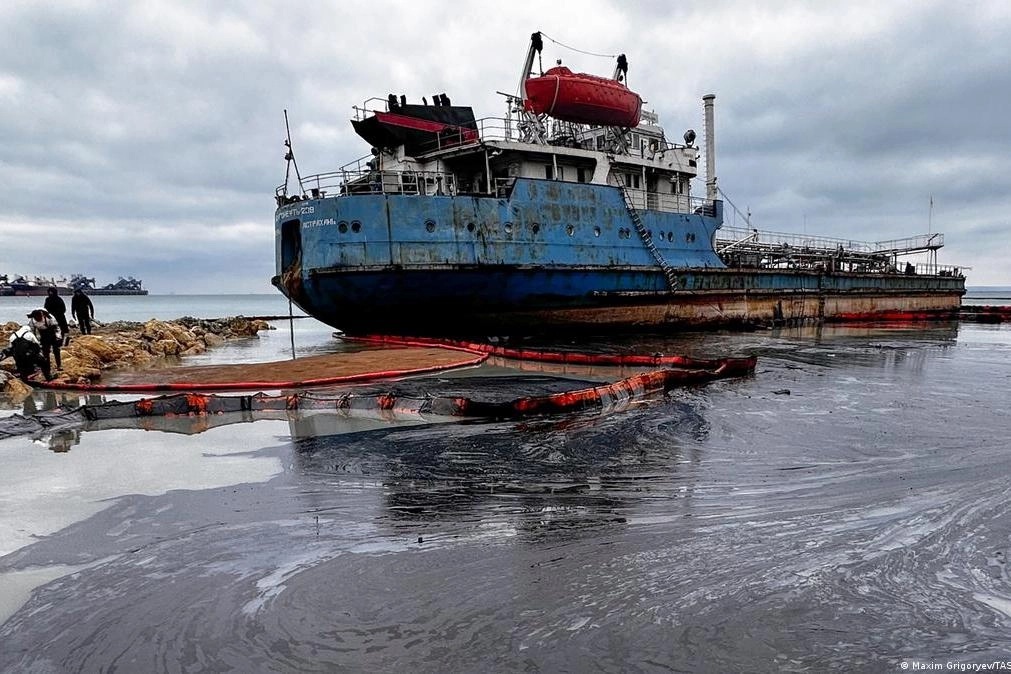
Russia has not rectified the consequences of the disaster involving two «Volgoneft» tankers in the Kerch Strait, which occurred almost two years ago and caused pollution in the waters of the Black Sea region. Oil slicks continue to drift across the sea, poisoning its marine life and polluting the coastline. Russia has failed to take the key step needed to prevent further accidents involving the spillage of thousands of tonnes of oil products – it has not banned the use of old mixed-service tankers. Consequently, hundreds of dilapidated Soviet-designed «river-sea» vessels are still being used for the transport and ship-to-ship transfer і Ship-to-Ship transfer (STS) is the transfer of cargo (crude oil and oil products, liquefied gas etc.) from one ship to another in the open sea or in the outer roadstead of the port, e.g. at anchorages; in the outer harbor, rather than at a quay within the port. of exported oil, fuel oil and other hazardous cargoes, and have become part of the so-called «shadow fleet» and a key link in the scheme to circumvent sanctions.
Russian war against Ukraine at sea has caused yet another form of marine pollution – spills of vegetable oil, which poses a threat to all living things no less serious than that posed by crude oil. The most striking tragic consequence of the war is the death of around 120,000 cetaceans in the Black Sea.
This article was produced in collaboration with The Insider, with the support of Journalismfund Europe.
On 15 December 2024, during a severe storm in the Kerch Strait, two Russian tankers, «Volgoneft-212» and the «Volgoneft-239», were involved in an accident; they were split in two and sank, causing a spill of petroleum products. Both tankers, which were over 50 years old, carried around 9,000 tons of fuel oil і Fuel oil is a petroleum product obtained as a heavy residue following the distillation of crude oil, after the separation of its light fractions (petrol, kerosene and diesel fuel), as well as from the processing of coal or oil shale. It is used as fuel for steam boilers, thermal power stations and ship propulsion systems. from Rosneft»s oil refineries to be transhipped onto other tankers in the outer roadsteads of the Kerch Strait.
A Russian court has ordered the nominal owners of two tankers – the companies «Volgatransneft» and «Kamatransoil» – to pay 34.2 billion Rubles in compensation, which they are unable to pay, whereas the actual beneficiary of these high-risk shipments – Rosneft, headed by Vladimir Putin’s friend Igor Sechin – has evaded any liability. The actual costs of cleaning up the oil spill in the Kerch Strait turned out to be five times less than the value of Sechin’s yacht.
Soon, autumn and winter storms will sweep up from the seabed and wash ashore thousands of tons of petroleum products, not pumped out of the tankers or collected in time, as well as tons of vegetable oil and carcasses of dead dolphins which have been drifting at sea for months.