


Ivan Rusev, PhD in Biology, Head of the Research Department of the Tuzly Lagoons National Nature Park, has monitored the human impact on the Black Sea for decades as the researcher of the Park. In an interview to Anna Lukinova, the author of the Center for Journalist Investigations, he tells about the impact of the Russian full scale aggression against Ukraine on the ecology of the Black Sea and Black Sea fauna – fishes, birds and other numerous living organisms.
The Tuzly Lagoons National Nature Park is the only Ukrainian sea nature park, not occupied by Russia. This is the place where we are able to collect information about impact of the war on natural ecosystems and biodiversity. Our sea part is 44 km long. We monitor it by feet, by tractor or jeeps when guests come. We look each day how the Black Sea feels itself and what the war brings us.
The most visible and tragic impact is the massive death of three species of сetaceans living in the Black Sea – Black Sea bottlenose dolphins, harbour porpoises and common dolphins. People usually call them all dolphins. We find their new mutilated bodies at the seashore almost every day. You should understand that only 5% of dead cetaceans are thrown at the seashore; the rest of them drown into the depth. It is the internationally recognized coefficient. That is why we should multiply the number of dead bodies, found at the seashore, by 20 and, then, we will get real number of dead dolphins. In total, at least 120 thousand dolphins died during the full scale war.
When we find bodies, we can determine causes of death by character of external traumas. If we see traces of nets and cut fins, then, it means that the dolphin got trapped into fishing nets. There is a large penalty for dolphins killed by fishing nets. Fishermen know about it and, instead of rescuing dolphins, they try to get rid of them – they cut their fins and tails and throw back into the sea. There were a lot of such cases before the war.
The full scale war brought many new factors, physical as well as chemical. Physical factors of negative impact became visible in the spring 2022 when active fighting erupted in the Black Sea.
The most widespread factor is acoustic impact. Active sonars on ships and submarines issue high-intensity sound waves at medium and low frequencies. This disrupts dolphins’ echolocation and spatial orientation, and also causes acoustic trauma and damage to the animals’ inner ears. The dolphin loses its sense of direction, becomes separated from its pod, and is unable to forage effectively (it needs up to 25 kg of fish per day). Eventually, it becomes distressed, may panic, and swim toward the shallows.
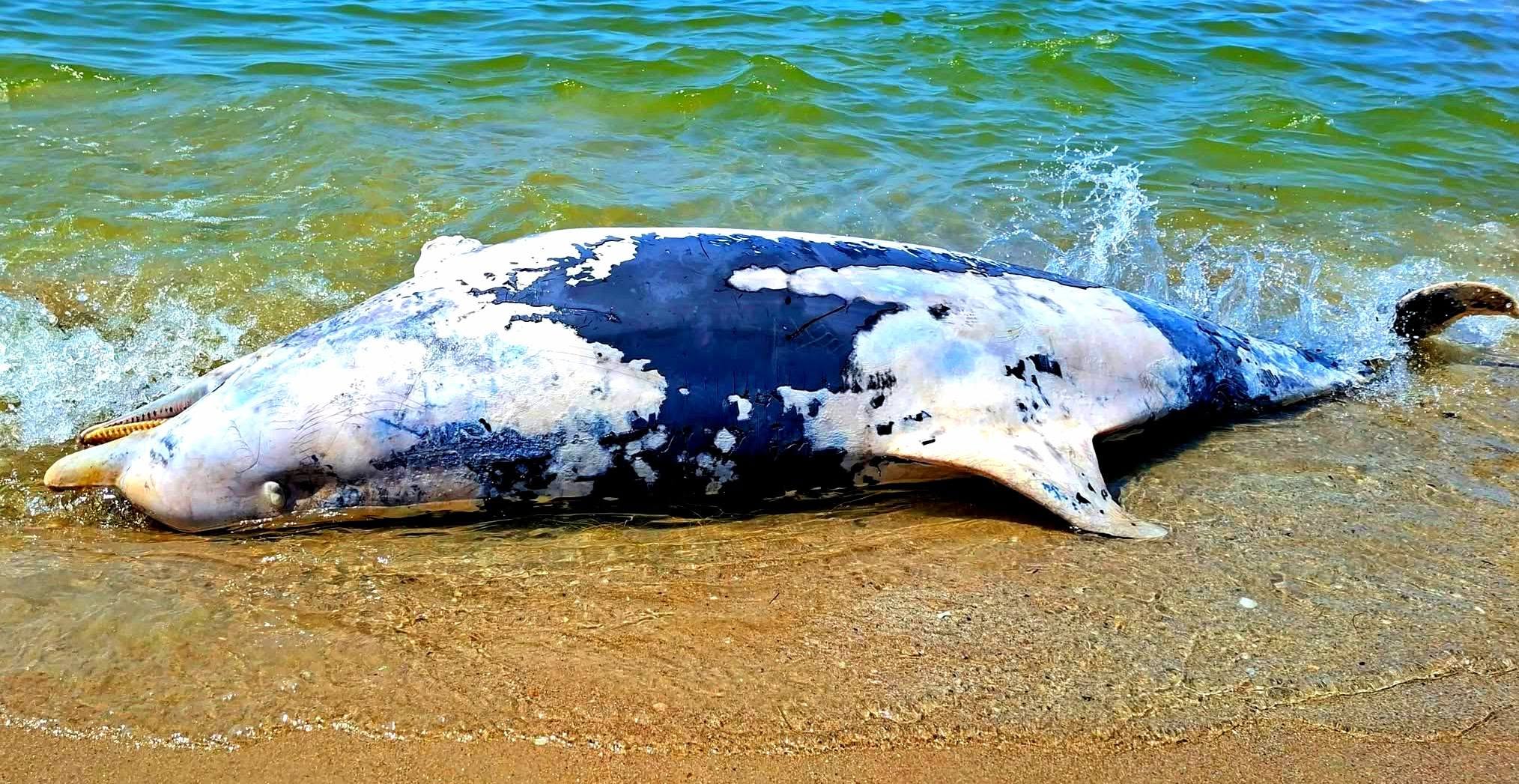
Dead dolphin at the seashore of the Tuzly Lagoons National Nature Park, June 2026. Source: account of Ivan Rusev in Facebook
The second factor is blast waves from airborne weapons. The use of guided air bombs and dropping munitions from fighter jets cause powerful blast waves in the water environment. Depending on distance, this can lead to immediate damage to soft tissues and internal organs (lung rupture, cerebral hemorrhage) or to the animal sustaining a concussion and losing its ability to hunt on its own.
The third factor is the impact of cruise missiles. Launches of «Caliber»-class cruise missiles from Russian ships and submarines generate a high-energy acoustic shock. To evade air defense systems, the missile flies at an extremely low altitude – just 10–20 meters above the water surface. The entire acoustic shock from the jet engine is directed straight into the water. If a dolphin is within a radius of 1–2 kilometers of the flight path and is swimming close to the surface, it experiences a severe acoustic shock, leading to disruption of its echolocation, disorientation, and panic. In addition, the animal may be injured by falling warheads or interceptor missiles launched by air defense systems.
And the fourth factor is the detonation of sea mines. The detonation of anti-ship mines (particularly Soviet-type drifting mines) causes an extreme increase in water pressure. Dolphins within a radius of several hundred meters from the epicenter of the explosion sustain fatal injuries. Mine explosions also cause the total destruction of fish populations—which form the basis of the dolphins’ food supply.
In addition, if a dolphin is near the site of an explosion, it may rapidly rise to the surface and leap out of the water out of fear. This leads to decompression sickness, just as it does in scuba divers. Due to the rapid ascent to the surface, the pressure drops sharply, and the nitrogen in the blood instantly expands, forming bubbles that block blood vessels, damage organs, and paralyze the dolphin. The same thing happens to humans – after all, both dolphins and humans breathe air.
The impact of war-related chemical factors began with the sinking of the cruiser «Moscow» in April 2022. On board the «Moscow» and other sunken Russian vessels were hundreds of metric tons of fuel (fuel oil, diesel), as well as munitions, including «Caliber»-type missiles. As the ships’ hulls are destroyed, all these toxic substances are gradually leaking into the water. Petroleum products and heavy metals create a persistent toxic background that intensifies with each new attack – such as the recent sinking of four Russian ships in Novorossiysk.
The second powerful chemical factor is the blast of the dam of Kakhovka Hydro Power Plant. Pollutants that had accumulated in our soil over decades were washed away by a flood of water into the Dnipro-Bug Estuary, and from there into the sea. These include hundreds of metric tons of various oils, fuel oil, crude oil, and fuel that had been stored at flooded industrial facilities and warehouses. At the same time, toxic sediment from the bottom of the Kakhovka reservoir, along with the contents of animal burial grounds and cemeteries – everything that had accumulated there over the course of 50 years—was washed into the sea. All of this material settled on the seabed – in what is known as the «benthic zone.» Some of the chemicals immediately entered the food chains of marine organisms, causing metabolic disorders and chronic poisoning.
The third factor is the fuel oil spill in the Kerch Strait, which began following an accident and the sinking of two old Russian tankers in December 2024. The ships were carrying several thousand metric tons of fuel oil. And although the Russian occupation authorities claimed to have pumped out most of the fuel from the flooded compartments, the spill is actually still ongoing. Satellite images show fresh fuel oil trails originating above the site where the tankers sank, as well as hundreds of large oil slicks that have been carried by currents over long distances. This fuel oil has catastrophically polluted the Crimean coast, and some slicks have reached the Odesa region and our park. It is important to understand that when the water temperature drops, the fuel oil polymerizes. It sinks to the bottom and hardens like asphalt, but as the water warms up in the summer, it softens again, rises to the surface, and actively poisons marine life. This is a cyclical process that can last for decades.
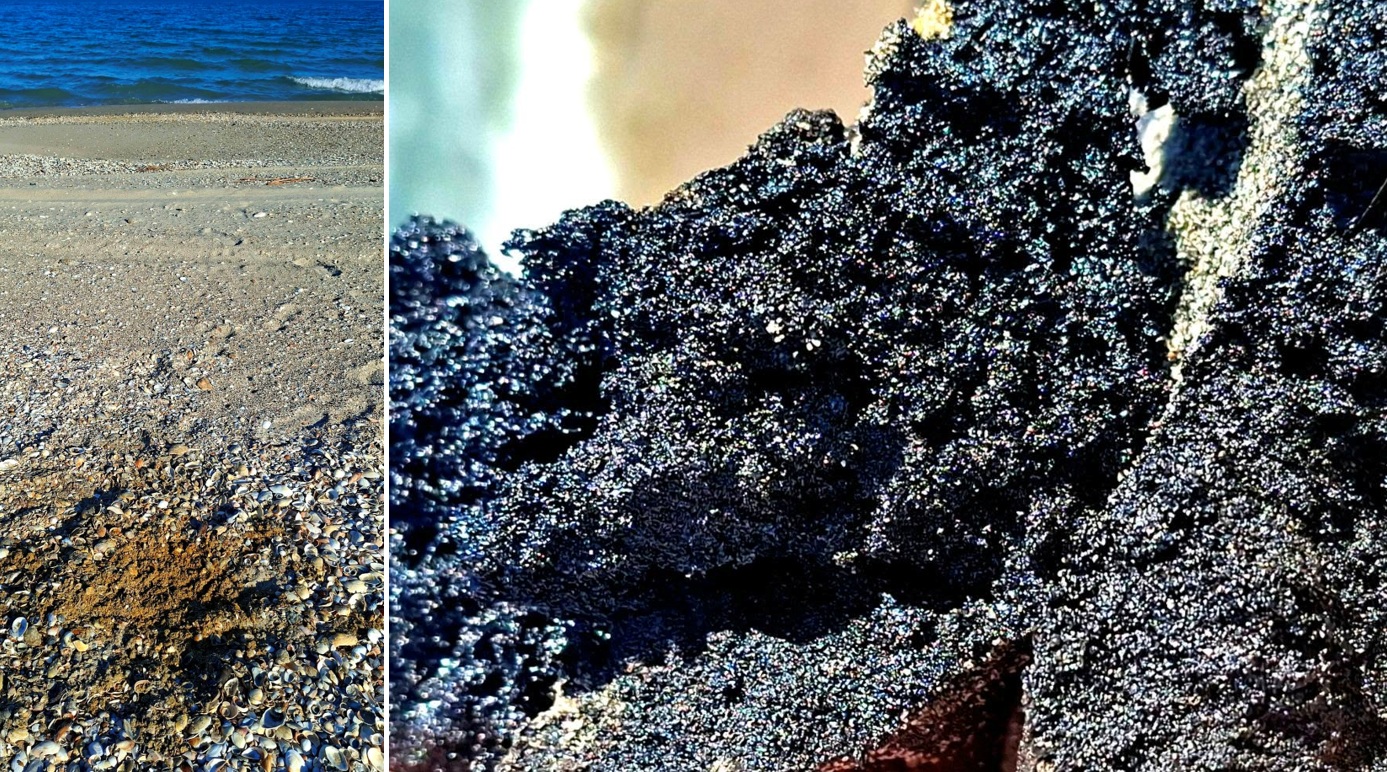
The sand polluted by fuel oil at the seashore of the Tuzly Lagoons National Nature Park, July 2026. Source: account of Ivan Rusev in Facebook
The fourth factor is vegetable oil spills resulting from attacks on Odesa ports. Russian attacks on the port of «Pivdennyi» in December 2025 and the port of «Chornomorsk» in February, April, and May 2026 led to a specific but extremely devastating environmental disaster. Tens of thousands of metric tons of sunflower and other vegetable oils spilled into the coastal estuaries: Sukhyi and Adzhalyk. Port authorities should have set up boom barriers and collected the oil, but this did not happen. As a result, all of it flowed into the open sea and spread 150 kilometers as far as the Danube Delta.
In large quantities, vegetable oil has proven to be more dangerous than petroleum. It lacks a pungent odor that would scare birds away, so they calmly land on the water at spill sites. The oil completely soaks into their feathers. The bird tries to clean itself with its beak and swallows a lot of oil, which disrupts its metabolism and damages its liver. But even so, it cannot clean itself on its own. The oil polymerizes so strongly on the bird’s body that even when people attempt to rescue it, such birds have to be washed several times. In winter, the situation is compounded by the fact that the oil disrupts the bird’s natural thermoregulation, causing it to simply freeze to death.
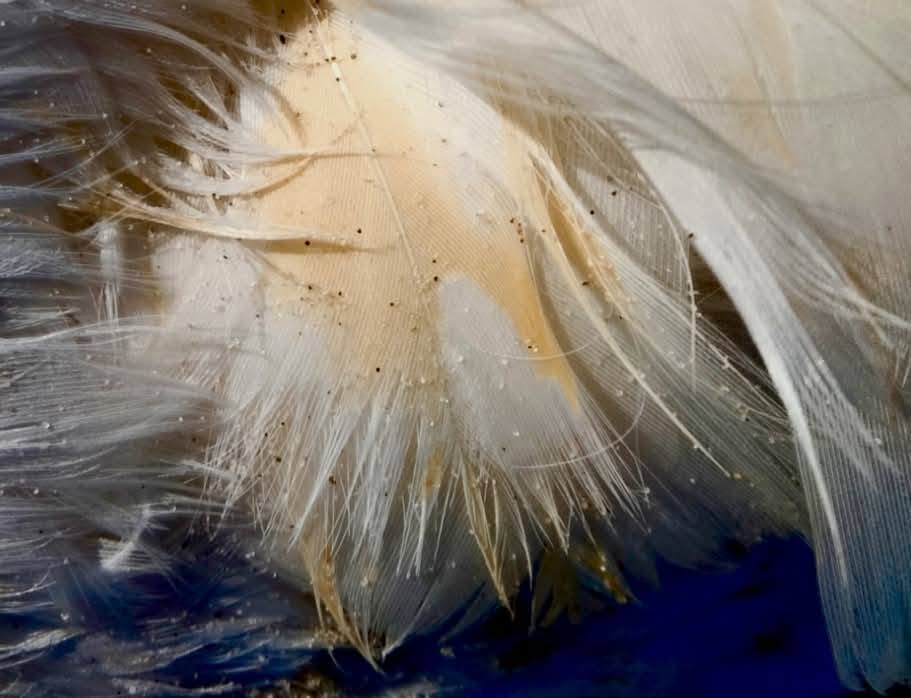
Feathers of swan, polluted by sunflower oil, March 2026. Source: account of Ivan Rusev in Facebook
These include loons, podiceps, swans, herons, and ducks. Imagine that this year they traveled enormous distances in the hope of finding a relatively warm sea and fish, only to be met with kilometers of oil slicks. There were no fish – they had all retreated to deeper waters. The Odesa Zoo tried to organize a rescue effort: it took in birds from the public and distributed them to people who could care for them. My son and three grandchildren took in 13 birds, tried to nurse them back to health, but in the end, they all died. In total, more than 5,000 birds died from the first two oil spills (the survival rate of oil-contaminated birds was practically zero).
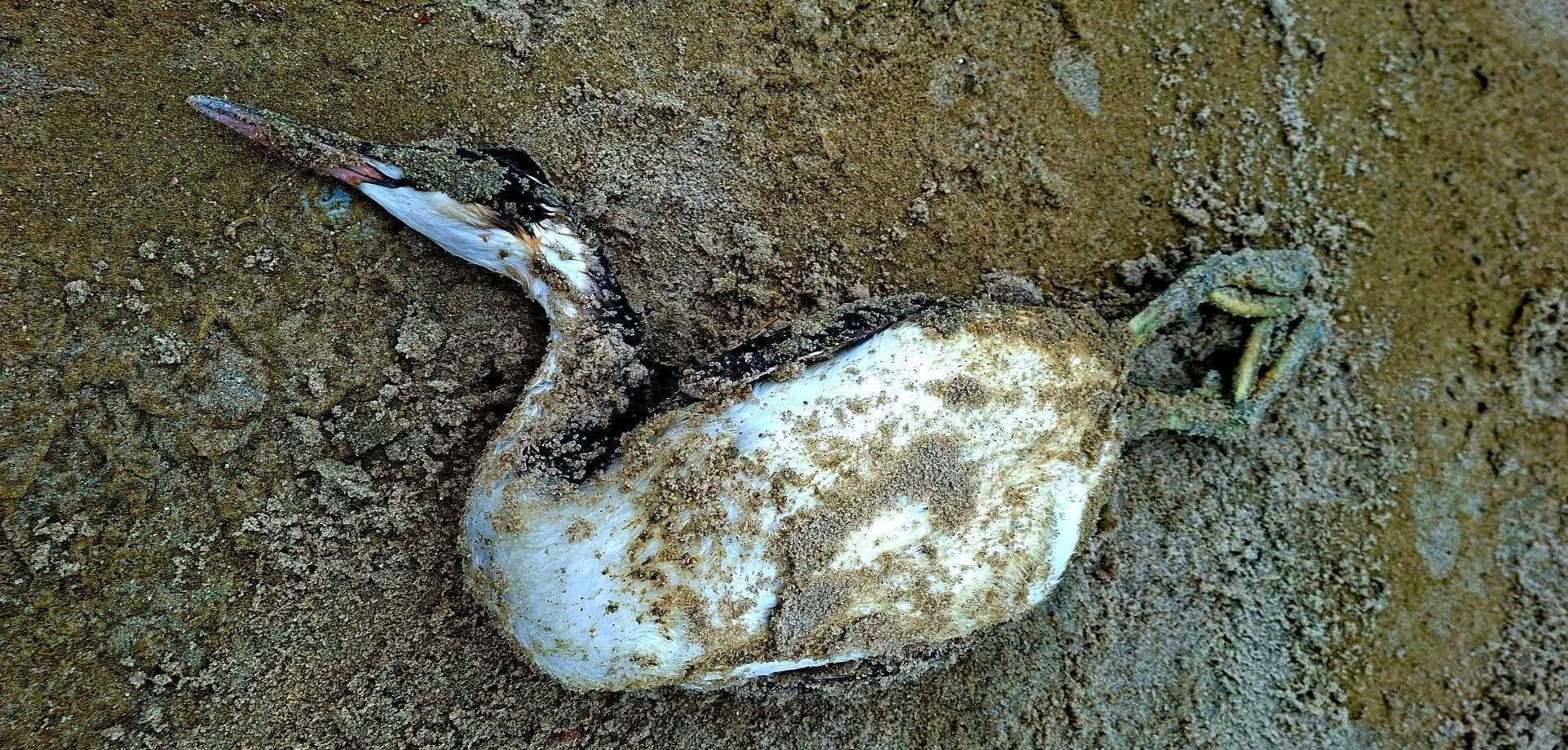
Dead podicep at the seashore of the Tuzly Lagoons National Nature Park, January 2026. Source: account of Ivan Rusev in Facebook
The oil spills also affected bottom-dwelling organisms. Since it was cold during the initial spills, the oil quickly thickened, sank to the bottom, and covered the benthos (bottom-dwelling organisms) with a dense film up to a millimeter thick. This blocked light and gas exchange. The result was a massive mass die-off: tens of thousands of dead seahorses, as well as countless crabs, jellyfish, and crayfish, were washed ashore along the coast of the Gulf of Odessa. In addition, when mixed with algae during storms, the oil slick was washed up on beaches and disrupted the vital functions of small invertebrates in the sand, which act as the coast’s natural cleaners.
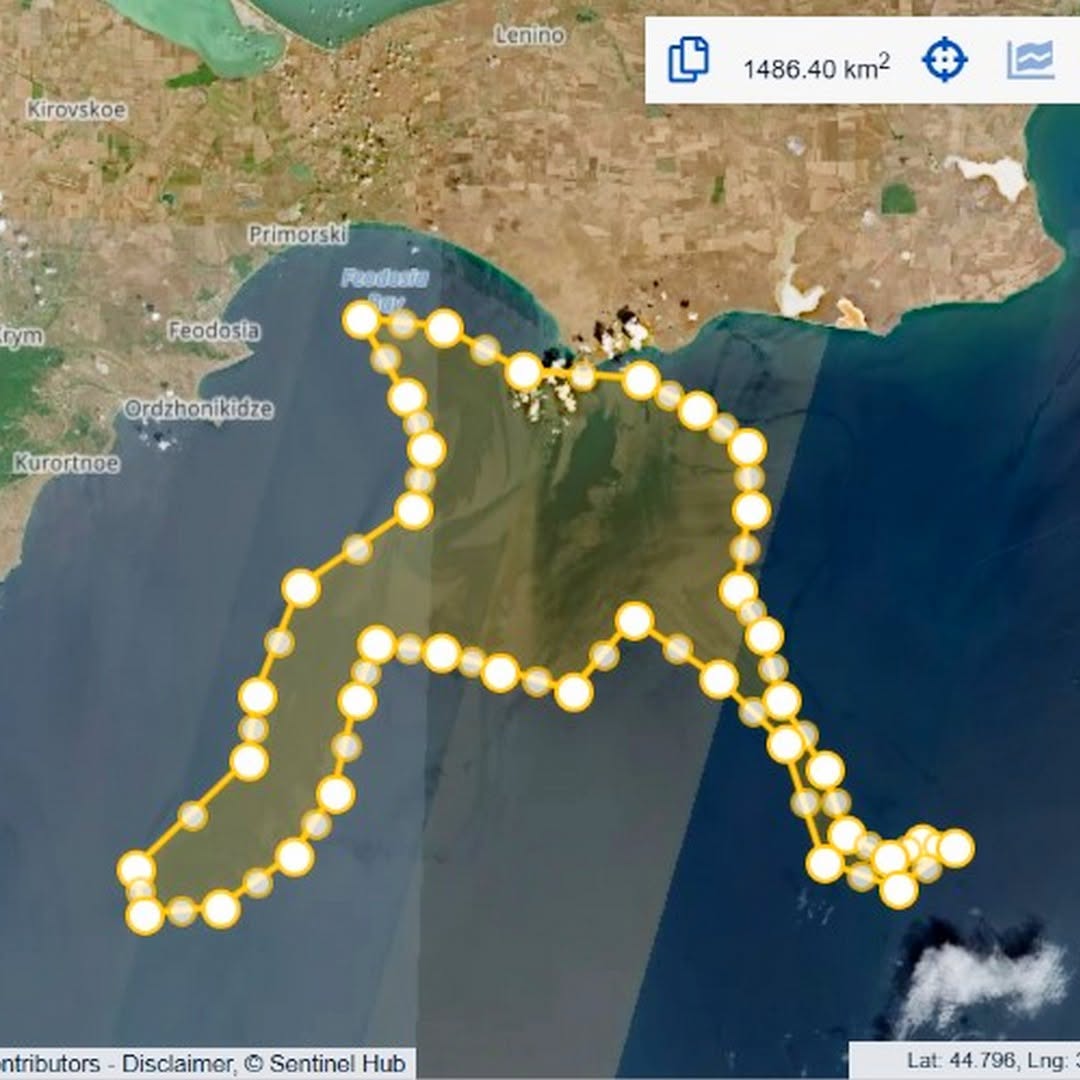
Pollution of the Black Sea in Feodosia Bay, caused by spills of fuel oil from Russian tankers «Volgoneft», drowned in 2024, and sunflower oil from reservoirs in Taman, beginning of August 2026 (according to Sentinel satellite images). Source: account of Odesa environmental activist Vladyslav Balinksy in Facebook
And the last, fifth chemical factor is rocket fuel and TNT that end up in the water as a result of constant shelling. The remains of rockets, aerial bombs, and downed drones contaminate the water with rocket fuel components and explosives – in particular, TNT. The situation is further complicated by the fact that old shells from World War II still lie at the bottom of the Black Sea, their casings now crumbling due to age and detonations.
Fuel components and TNT are extremely corrosive compounds. They paralyze the nervous systems of aquatic organisms – living organisms that inhabit the sea. These toxins have the ability to accumulate: first, they enter microscopic zooplankton and phytoplankton; then, they enter the fish that feed on this plankton; and finally, they accumulate in the fatty tissues of dolphins and birds.
The combination of physical factors (shelling, explosions, military operations) and chemical poisoning leads to tragic consequences for all marine life. And dolphins are very sensitive creatures; they serve as a kind of indicator of the overall environmental situation. We spoke with the «Carefree Sea» Center in Sevastopol and the «Delfa» Center in Novorossiysk. We used their data to assess the overall scale of the disaster.
But the official explanation from the Russian side is simply laughable: due to the «political situation,» fishing has decreased, dolphins have stopped getting caught in nets, and their population has multiplied uncontrollably. They began to run out of food, their immunity declined, and a plague – a so-called epizootic, or mass death from infectious diseases – began.
The only true statement here is the one about starvation and the associated decline in immunity. But cetaceans do not starve because there is a shortage of fish in the sea, but because their echolocation system is impaired due to damage caused by various factors of war, and they lose the ability to communicate with one another and obtain food. When a dolphin goes hungry, it begins to burn its internal fat, which is chemically contaminated (because the fish the dolphin ate were contaminated). The body quickly becomes toxic; this significantly weakens the immune system, making the dolphin vulnerable to various viruses and infections (such as the morbillivirus).
While approximately 120,000 cetaceans died during the entire full-scale war, in the first half of 2026 alone that number reached about 20,000, and the trend continues. After all, the factors we discussed above are not going away. On the contrary, they have a cumulative effect. And even after hostilities end, we will continue to see the devastating impact of the war for decades to come.