

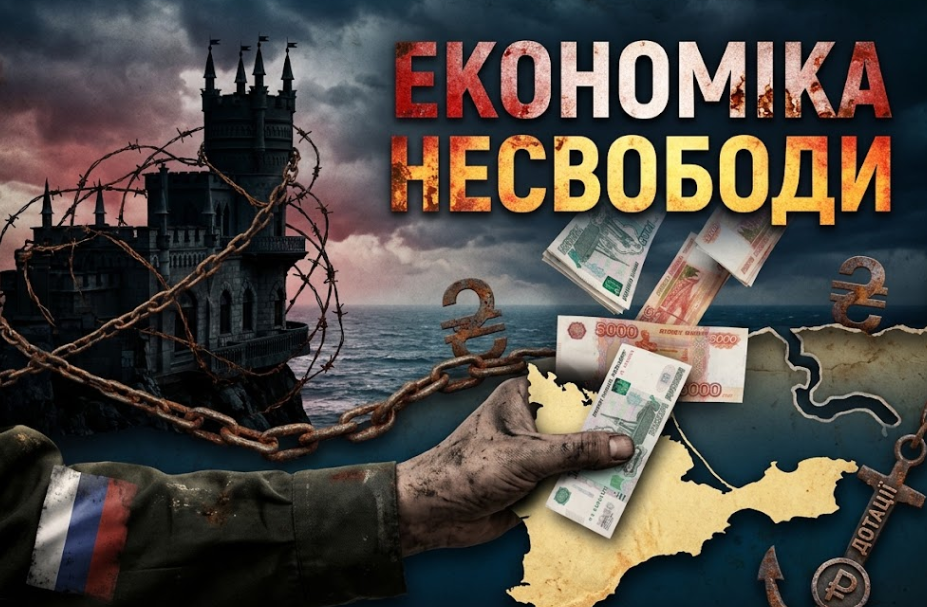
Prior to the Russian occupation, Ukrainians had been discussing various models for the economic development of Crimea. Debates raged between supporters of the military-industrial and the resort-and-services concepts. But in both cases, the aim was to achieve greater economic self-sufficiency for the autonomous region. The Russian occupation has shattered these plans. The invaders have increased the dependence of peninsula on funds from the federal budget and turned it into a springboard for further aggression.
In our series of articles entitled ‘The Economy of Oppression’, we will examine which Crimeans have lost out and which have gained financially as a result of the Russian occupation.
Andrii Yanitsky, for the Center for Journalist Investigations
On 28 February 2014, the controversial Russian politician Vladimir Zhirinovsky stood on the steps of the building of Sevastopol City Administration, which had already been seized by the Russian occupants, and waved a wad of banknotes.
“I’m giving 30,000 hryvnias for flowers [for the women]. Hand them out to old spinsters, pregnant women, divorcees, married women and those with lots of children! So that they all know that Russia is a rich country. We’ll give everyone everything!” – shouted the politician (now deceased; he died in Moscow in 2022).
Instead of giving the money to the women, he handed it over to his political ally in Sevastopol, Ivan Komelov. Komelov replied that “the money would be accounted for” and passed on to the office of Russian occupation governor of Sevastopol Alexei Chaly.
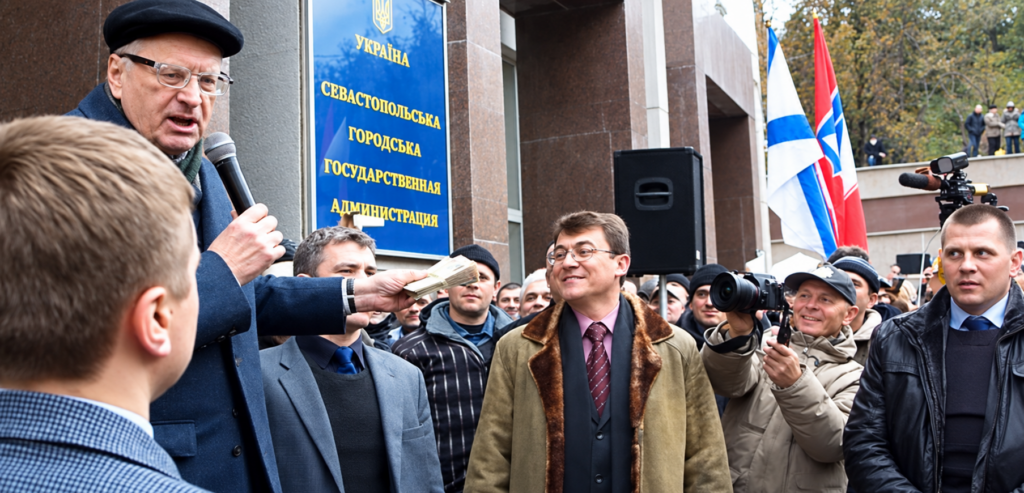
Zhirinovsky gives money in occupied Sevastopol in March 2014. Screenshot of video of Russian propagandist site ForPost (quality of photo enhanced).
This tragicomic scene sums up the entire economic policy of the Russians in Crimea. After a brief period of political bribery, the money ended up in the hands of the occupants themselves. But let us take it one step at a time.
Year of grand promises
In April 2014, Crimean pensioners received a quarter more money from the Russian occupation authorities than they had the previous month. In May, the extra-payment rose to 50%; in June, to 75%; and from July onwards, it amounted to 100% of the pension previously awarded under Ukrainian law. Thus, in just four months, pension payments for Crimeans had effectively doubled. No formal procedure was required; the extra-payment was calculated automatically. (By 2015, the occupied peninsula had switched to the Russian system for calculating pensions, and payments were reduced for certain categories of pensioners.)
At the same time, the Russian occupation authorities were increasing the salaries of public employees. Not by a factor of two, but for many people the change was noticeable. The peninsula was literally awash with money.
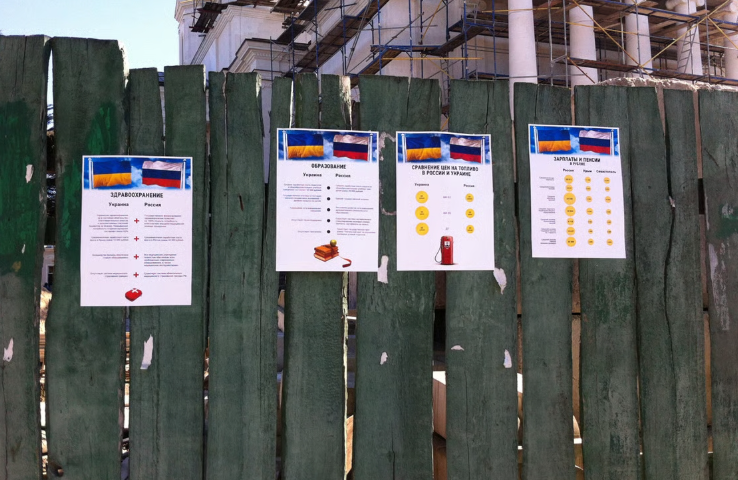
Propagandist leaflets on the fence in Simferopol with comparison of prices and salaries between Russia, Autonomous Republic of Crimea and Sevastopol on the eve of illegal referendum in March 2014. Photo: Irina Garina \ “Novaya Gaseta Yevropa”
The scale was enormous. At the start of the occupation, there were 524,000 pensioners in Crimea (excluding Sevastopol, though the situation there was similar), whilst a further 140,000 people were employed in state-funded institutions. Together, this amounts to almost 34% of the Crimean population. And if we take their families into account, it is reasonable to assume that the majority of the Crimean population received financial incentives from the Russian occupants during the first year of the invasion.
In May 2014, the Russian occupation authorities allocated nearly 45 billion Rubles (around 950 million Euros at the exchange rate at the time) as additional expenditure to increase pensions and wages on the peninsula.
This policy was tantamount to large scale financial bribery. Russia attempted to buy the silence of the Crimean people with money, while those who objected were dealt with by the Russian para-military called self-defence” forces.
The rise in subsidies was not the result of economic growth. Factories did not suddenly start producing twice as many goods, nor did the number of tourists double. It was Moscow that was pumping money into the pockets of Crimeans.
The Ukrainian hryvnia remained in circulation for some time, but the Russian authorities gradually replaced it with Rubles. Moreover, an inflated exchange rate of 3.8 Rubles to the hryvnia was applied when converting salaries. For price and tariff adjustments, the rate was 3.1 Rubles to the hryvnia. For a short while, residents of the peninsula felt as though their wages had risen while prices had remained the same. (You can’t fool the economy: prices also rose over time, but we will cover this in detail in a separate article).
The change in currency was part of a wider transformation. Companies were switching to Russian legislation and converting their documents to Russian formats – under simplified procedures. For some companies, this opened up new opportunities and new markets. For others, however, it meant losing partners and markets.
A special tax policy was in place for the occupied territories. In January 2015, Russia introduced a free economic zone regime on the Crimean peninsula. Participants in the scheme were granted exemptions from income tax, property tax, land tax and insurance contributions.
This was a response to international sanctions, designed to encourage companies to invest in occupied Crimea. At the same time, such companies would have to recognise the peninsula’s status as part of Russia and legitimise the occupation.
Russia has also begun to pour billions into rebuilding the peninsula’s infrastructure in order to integrate it into its own economy. Much of this spending was intended to replace transport and energy links with mainland Ukraine. In August 2014, the Russian government approved a federal target program for the socio-economic development of Crimea and Sevastopol.
Unlike one-off bribes to the population, investment in infrastructure had long-term economic consequences. It was intended to create demand for construction works, materials and transport in Crimea, and thus to support the peninsula’s economy. In reality, money from the federal budget often ended up in the pockets of Russian contractors; in other words, the benefits went to companies close to the occupants themselves, which were involved in the distribution of the funds.
So, at the start of the occupation, Russia used three economic tools to bribe the local population:
– immediate payments into pensions and the salaries of public sector employees
– tax breaks for businesses
– investment in infrastructure.
But there was another important consequence of this policy. Crimean economy was becoming increasingly dependent on financial injections from the Russian occupation authorities.
How Ukrainian authorities underpinned invaders
Russia seized Crimea by force, but was unable to immediately provide it with everything it needed. The peninsula remained dependent on mainland Ukraine: electricity, water and food supplies continued to come from Ukraine in the early days following the occupation. This dependence on the mainland potentially gave Kyiv economic leverage over the occupants, but it was in no hurry to make use of it.
At the time of the occupation, Crimea was approximately 84% dependent on supplies from the Ukrainian power grid. Despite this, the Ukrainian authorities did not cut off supplies, and at the end of 2014 agreed (!) to new energy contracts with Russia. The contract provided for 100% of the occupied Crimea’s electricity needs to be met by Ukraine, which was a condition for the supply of Russian electricity to Ukraine, according to the Centre for Journalist Investigations.
The situation only changed in November 2015, when unidentified activists (rather than the Ukrainian government) damaged electricity pylons in the Kherson region. In other words, Russia had nearly two years to set up an alternative energy supply route.
Ukrainian trade in Crimea did not cease immediately either. In August 2014, the Verkhovna Rada of Ukraine passed a law establishing the “Crimea” Free Economic Zone. As reported by the Centre for Journalist Investigations, in the first year alone since the law came into force, Ukrainian goods worth approximately $1 billion were officially (!) imported into the occupied peninsula. Ukrainian businesses continued to profit from the occupation – and all entirely legally. It was not until September 2015 that activists (rather than the Ukrainian government) organised a trade blockade of Crimea. The supply of most Ukrainian goods to the peninsula was not officially banned until January 2016, while the law on the ‘Crimea’ Free Economic Zone remained in force until as late as 2021.
Unlike the blockade on the supply of electricity and goods, the supply of water via the North Crimean Canal was cut off as early as spring 2014. This dealt a blow to irrigated agriculture, which depended on the canal. However, some Ukrainian politicians attempted to lobby for the resumption of water supplies to the peninsula even while the occupation was underway.
The spoils economy: money was handed out to some, while others were robbed
While Russia was increasing pensions and wages for some Crimeans, it was taking away enterprises, land and property from others. The occupants’ generosity had a downside.
As early as March 2014, Moscow ‘nationalised’ – and in essence stole – 131 Ukrainian state-owned enterprises in Crimea, including all the ports, the railway and the world famous ‘Magarach’ and ‘Massandra’ wine-making enterprises.
The occupants called this ‘nationalisation’, although legally Ukraine had not relinquished its ownership rights. Russia had no legal grounds to dispose of this property. The occupants subsequently transferred some of the seized enterprises to private owners with close ties to the Kremlin.
Among the main beneficiaries of the seized Ukrainian assets were entities linked to individuals in Putin’s inner circle – Yuri Kovalchuk and Arkady Rotenberg. The former acquired “Massandra” and “Novyi Svit” wineries. The latter acquired health resorts “Dyulber”, “Miskhor” and “Ai-Petri”.
Over time, the invaders’ appetites grew. In 2022–2023, the Russian occupation authorities “nationalised” a further 700 properties belonging to “foreign citizens” (read: Ukrainians). These included properties belonging to Ukrainian businessmen such as Rinat Akhmetov, Ihor Kolomoyskyi, Arseniy Yatsenyuk and others.
The Centre for Journalist Investigations has an entire section on “Crimean-style nationalisation”, where it is clear that the more time that passed since the occupation, the more brazen the Russians became.
Recently, international courts have begun to hand down their first rulings in favour of Ukrainian companies whose property in Crimea was stolen. Ihor Kolomoyskyi is set to receive $11.5 million from the Russians for the stolen Belbek Airport near Sevastopol. PrivatBank is to receive $327 million for its lost Crimean assets. Meanwhile, the European Court of Human Rights has ruled that the systematic expropriation of property by the Russians in Crimea is unlawful.
Moscow’s money as a drug
Last year, in 2025, Crimea received over 140 billion Rubles (around 1.5 billion Euros) in non-repayable financial assistance (referred to in Russian terminology as “grant funding”) from the Russian budget. This is more than the peninsula generated itself; to be precise, it accounted for 53% of the republic’s total budget revenue. In 2024, the figure was even higher – around 63%. The figure for 2023 requires further verification of the revenue structure.
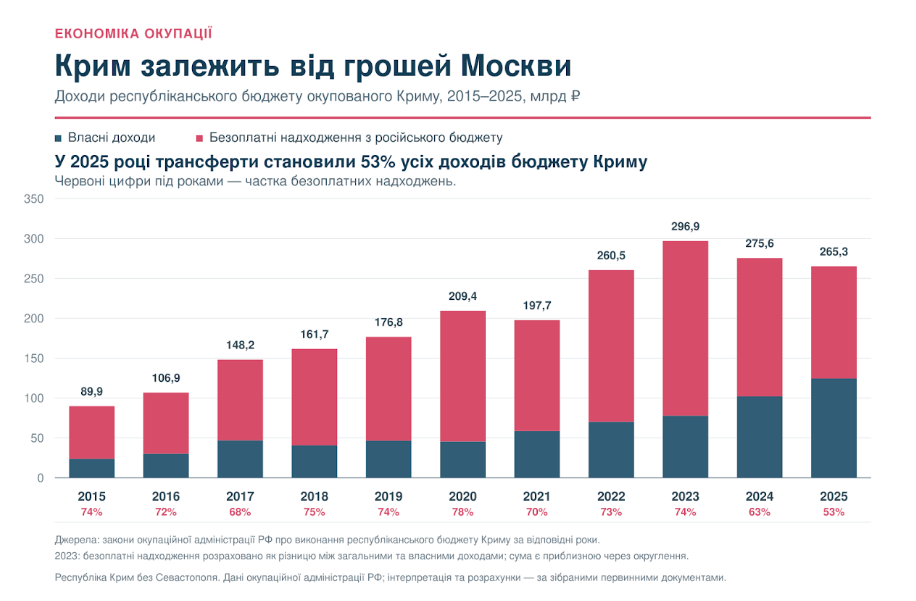 Calculations were made on the basis of law and official announcement of Russian occupation administration in Crimea about execution of budgets. Grants were calculated as the difference between general and own revenues with the use of cloud AI agent OpenAI Codex on the basis of GPT-5; results are examined with the use of AI-agent Claude Cowork.
In reality, even more money was spent on maintaining the peninsula, as the figures in Diagram 1 do not include expenditure on Sevastopol – which has a special status – nor do they take into account expenditure on infrastructure, the occupation army and pensions; these are paid directly from the Pension Fund, bypassing the Crimean budget.
Yet even so, for the Russian budget, bloated by petrodollars, such expenditure was not exorbitant. For example, in 2025, inter-budgetary transfers to occupied Crimea amounted to the equivalent of 0.32% of total expenditure from Russian federal budget (or 0.41% if Sevastopol is included).
A sceptic might say that, under Ukrainian rule, Crimea also received transfers from the central budget, so nothing has changed? Yet a great deal has changed. Although Russia and Ukraine have different rules governing inter-budgetary settlements, they can be compared.
Back in 2019, the “Black Sea Strategic Studies Institute” proposed comparing the money collected on the peninsula for the local treasury with budgetary expenditure.
Researchers have termed this indicator “the coefficient of financial independence of territories”. We have carried out further calculations based on the methodology proposed by the Institute. According to our assessment, prior to the occupation, tax revenue coverage of Crimean budgetary expenditure was significantly higher than during the years of Russian occupation.
To put it simply: Crimea is far more dependent on money from Moscow than it ever was on money from Kyiv. Just as an abusive partner forbids his partner from working so that she cannot leave him, keeping her tied to his bank card.
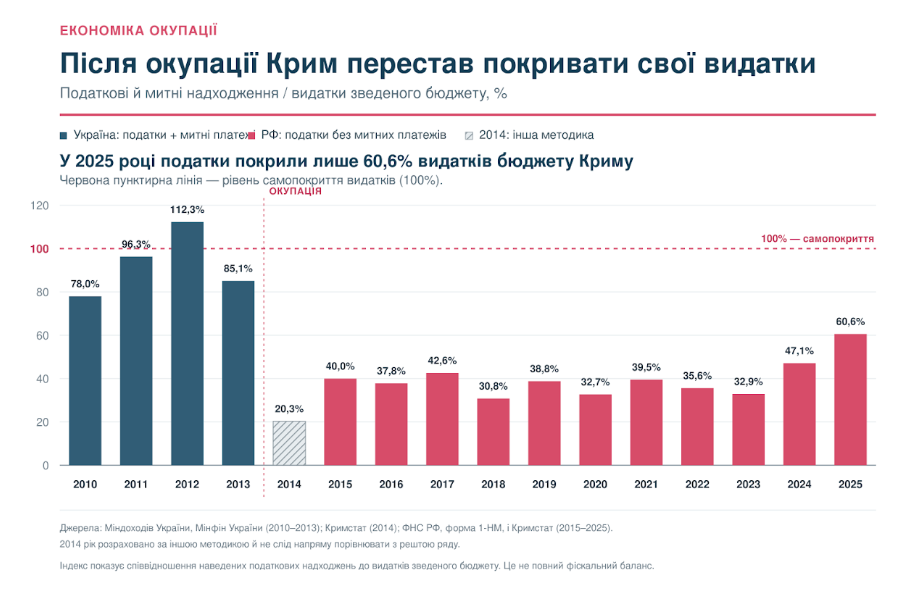
Relationship between revenues from tax inspection and customs office and expenditure of Crimean budget. It is calculated on the basis of the data of Ukrainian Ministry of revenues, official and non-officials sources within Russian occupation authorities, tax and customs reports, data of Crimean State Statistical Office. Russian data are partially projected as Russian reports are non-transparent and incomplete. 2014 data is an evaluation. Calculations are made with the use of cloud AI-agent OpenAI Codex, GPT-5; results are examined with the use of AI-agent Claude Cowork.
***
Next article of Andrii Yanitsky within a series “The Economy of Oppression” will focus on the fairness of distribution of Russian money between Crimean residents.