

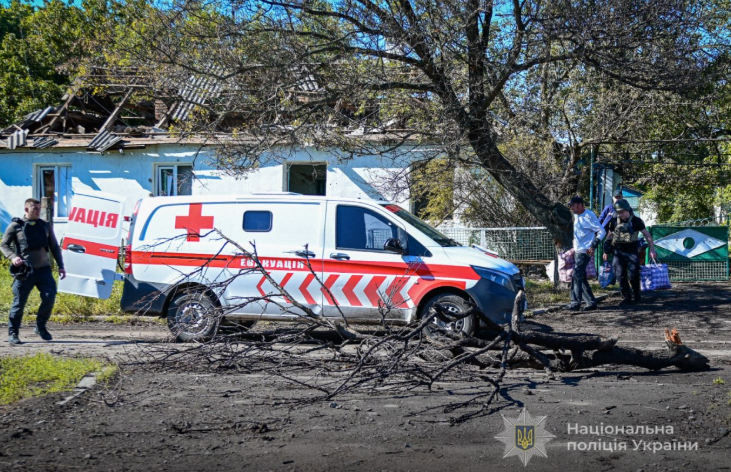
Russian attacks on frontline communities in Zaporizhzhia oblast intensify. Today people, who earlier refused to leave their homes, decide to evacuate after direct strikes on their houses or death of their neighbors. Each evacuation case looks like special operation because frontline territories are very close to kill zone. Policemen, the military and humanitarian organizations work together to evacuate people from settlements being hit daily by Russian artillery and FPV-drones. The Transit Center in Zaporizhzhia is the first safe place for evacuated people who lost everything. Refugees can renew their documents, receive assistance and find temporary accommodation.
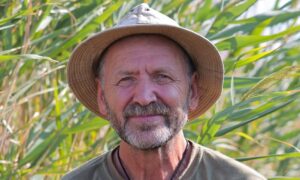
«Drones make life impossible. You do not see it but when you go out – it immediately appears near you. Now we can recognize various drones, «Grad» [self-propelled rocket launcher], artillery. Dogs and cats are already used to these sounds. As soon as they hear them, they run to hide. That is why I kept doors in the house and barn open, in order to hide inside if drone would attack», as says 68 years old Kateryna Dmytrivna Yudina from Preobrazhenske community in Polohy district of Zaporizhzhia oblast. She left her village after Easter when Russians significantly intensified the shelling of frontline territories. Terrifying deadly munitions became usual things for local residents.
«There are a lot of cluster munitions. When they launch it – some of them do not explode. Once it gets soggy, on the second or third day, I collect them into a bucket and throw away. Cluster munitions look beautiful, like chocolate candies», as almost routinely remarks the woman.
When confronted with concerns about the danger of such actions, she brushes them off like an experienced bomb disposal expert: «There are no whiskers (components of detonator – ed.), they fell apart, it will not explode. But if you step on munitions, then, you can lose your head and legs».
Ms. Kateryna had the unfortunate experience of being caught in the shock wave from the explosion of a guided aerial bomb; she hid from «shaheds» and looked into the sky with fear of finding drones there. Finally, when Russian strikes on the village became continuous, she decided to leave.
«They explode. Once you are outside – you should hide immediately because drones do awful things. When you heat the stove, you think – if drone will strike, you will be covered by the soot for the rest of your life. I closed my house, crossed myself and left», as says the woman.
The first safe place after leaving home
People sometimes stay in their houses until the danger directly touches them. That is what happened with 69 years old Lubov Volodymyrivna Prysyazhnuk from Novorozivka village. After the strike of Russian shell, the neighboring house was completely destroyed whereas all windows and doors in Lubov’s house were broken. The woman called hot evacuation phone line and asked to be evacuated with her husband.
Now Lubov Pryzyazhnuk, as well as Kateryna and dozens of other people whose housed and lives were destroyed by the war, stay in the Transit Center for evacuated people in Zaporizhzhia. It has been set up in November 2025. It became the first center in Ukraine to combine all governmental services for people who lost their homes – from renewal of documents to healthcare and temporary housing. Since its launch, over 9 000 people have received necessary services in the Transit Center.
«Zaporizhzhia approach towards the work of the Transit Center has already become the basis for similar institutions in other regions. The unique feature of our Center is that multidisciplinary team, strengthened by partners from humanitarian organizations, works in one location», as told to CJI Svitlana Lysenko, the Head of the Department of Social Assistance of Zaporizhzhia Oblast State Administration.
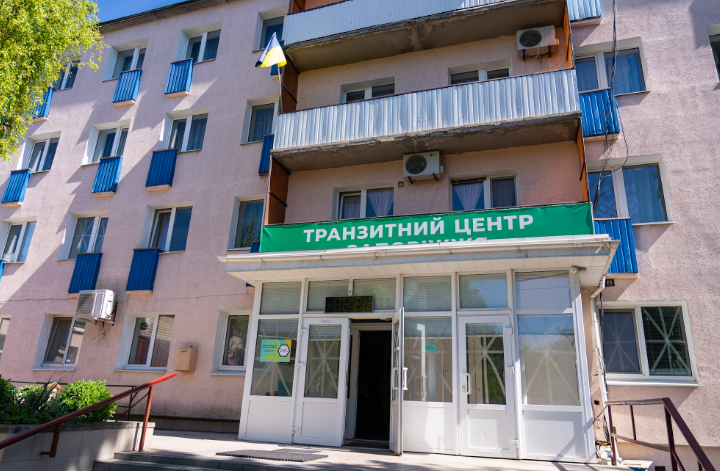
Transit center in Zaporizhzhia has worked since November 2025.
It involves public officials of the Pension Fund, Employment Center, the Department of Social Assistance, representatives of banks, charitable organizations and foundations, lawyers, psychologists.
«People do not need to waste their time and resources for visiting various governmental bodies in the city. For example, they can get the certificate of internally displaced person directly in the Center on the day of their visit or next day. Person can get accommodation, receive necessary documents and continue its trip. Important sphere of our work is employment: over 100 people found job under assistance of the Employment Center», as says Svitlana Lysenko.
Humanitarian organizations play an important role for the work of the Center. It is difficult for Ukrainian governmental authorities to satisfy all needs of people who were forced to leave their homes. That is why a number of civil society organizations are involved into the work of the Center: «Proliska», «Pravo na zakhyst», «Skhid SOS», «Posmishka», «ARTAK» etc. They deliver humanitarian and financial assistance, psychological support and legal consultations.
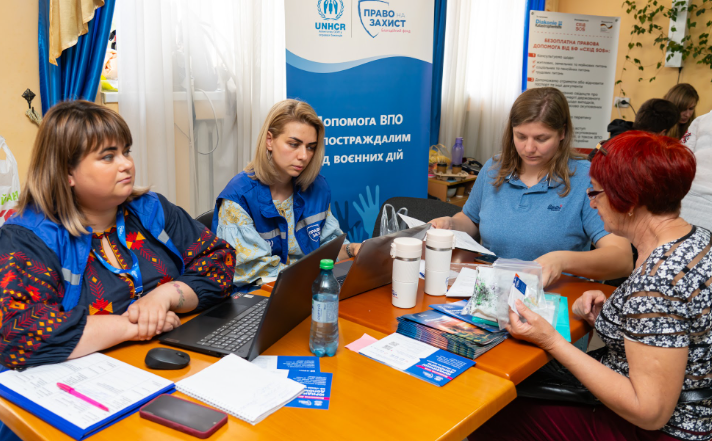
Representatives of public authorities and non-governmental organizations work in the Transit Center
The Center gives mobile phones of people who lost their communication devices during evacuation. It helps them to renew contacts with their relatives and to receive necessary information from governmental bodies.
According to the Department of Social Assistance of Zaporizhzhia Oblast State Administration, evacuated people received financial assistance from international partners for over 90 million UAH. As Svitlana Lysenko says, this assistance is very important for evacuated people and regional authorities as they are able to direct scarce budgetary resources for other critical needs.
Another unique feature of the Center is the creation of single database of evacuated people. It is maintained by the Department of Social Assistance. Thanks to database, the authorities are able to identify people’s needs and follow them after they leave Zaporizhzhia.
At the beginning, people could stay only seven days in the Transit Center. Then, this term was increased to 21 day. The term was extended because some people arrive without documents lost during evacuation or fighting. People can renew documents in the Center but it often requires additional time.
The Transit Center is located on the basis of former geriatric ward adapted for people with low mobility. Now there are 100 places for people with low mobility. All necessary conditions are provided for their safe and comfortable living.
75 years old Lidia Ivanivna Borysenko from Yurkivka village is one of them. In 2022, she lost her leg as a result of Russian strike. «When the war began, something fell down from the roof and broke my leg. Two neighbors were wounded», as recalls the woman. After medical treatment, she came back home because she could not leave it.
As an outcome of continuous Russian shelling, her health seriously worsened and she was evacuated to the Transit Center. She is maintaining contacts with people who still reside in her native village. She says that situation is worsening every day.
«It is very noisy there. Yesterday I was told that our street was hit again. Every house is already damaged», as says Ms Lidia.
Each evacuation like special operation
Russian troops significantly intensified the shelling, according to the data of the Main Department of the National Police of Ukraine in Zaporizhzhia oblast. Last year there were 500-600 strikes per day on average. Today this figure often reached one thousand strikes. Evacuation of civilians is one of key spheres of the activity of Ukrainian law enforcement personnel.
«Since the beginning of this year, we have already evacuated over 800 people from dangerous territories. There are 202 children and 80 people with low mobility among them. For the most part, we help older people with low mobility to get to safer places», as told CJI Anna Tkachenko, the Head of Communication Unit of the Main Department of the National Police of Ukraine in Zaporizhzhia oblast.
According to policewoman, each evacuation today is thoroughly planned special operation. Policemen work in close cooperation with the military. Soldiers provide protection and radio electronic means to counteract Russian drones. The sky over frontline settlements is full of FPV-drones. They purposefully attack civilian transport. Outcomes of these attacks are killed civilians, destroyed cars and houses.
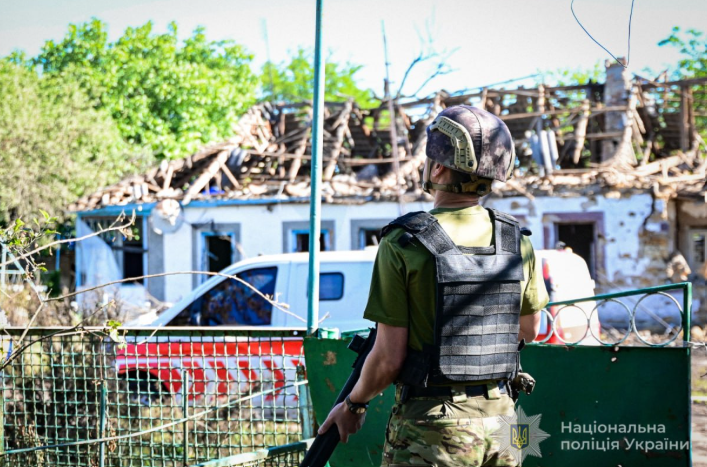
Each evacuation from frontline territories is the well developed operation of policemen and the military. Photo: the Main Department of the National Police of Ukraine in Zaporizhzhia oblast
Army chaplains are also involved into evacuation measures. They help with armored vehicles and support people on their way out of dangerous territories. Special transport, adapted for needs of bedridden people, is used for evacuation of people with low mobility.
The work of police in frontline communities is not limited to evacuation of people. Policemen provide security for critically important work of municipal services – from installation of anti-drone nets to renewal of electricity supply after Russian shelling.
At the same time, policemen themselves are under permanent threat. According to Anna Tkachenko, teams of policemen have been under attacks of Russian drones almost each week. Policemen have been wounded and their transport has been damaged or completely destroyed. She recalls recent case in Malokaterynivka village.
«Once it has been large and flourishing village. Today it is almost empty. There are just a few residents there, mostly aged people who refuse to leave. Old woman was killed during Russian shelling and policemen went to the village, in order to evacuate her body for decent funeral. The team was hit by FPV-drone, policemen were wounded and their car was damaged», as says Ms Anna.
Hoping to come back home
Accommodation in places of temporary housing is proposed to everybody in need in Zaporizhzhia. There are 54 places in the city. They can accommodate over 4.5 thousand people. After temporary accommodation, the evacuated people are proposed to go to more safe regions. However, the majority of evacuated people would like to stay in Zaporizhzhia as they would like to be closer to their native villages and cities.
«It is very good here. The staff is very attentive. They provide good meals. Doctors provide medical treatment, and drugs are free of charge. If possible, I would stay here», as says Lidia Ivanivna. She is waiting for new wheelchair and replacement of her prosthesis in the Center. She is looking for the next place of temporary housing.
«If they would organize permanent housing here, it will be good. I was proposed to go to Western Ukraine, now – to Kyiv. But I would like to stay here», as says Kateryna Dmytrivna.
As many other residents of frontline communities, our interlocutors follow the news and maintain communication with their compatriots. They still hope to come back home, where they spent their lives.