

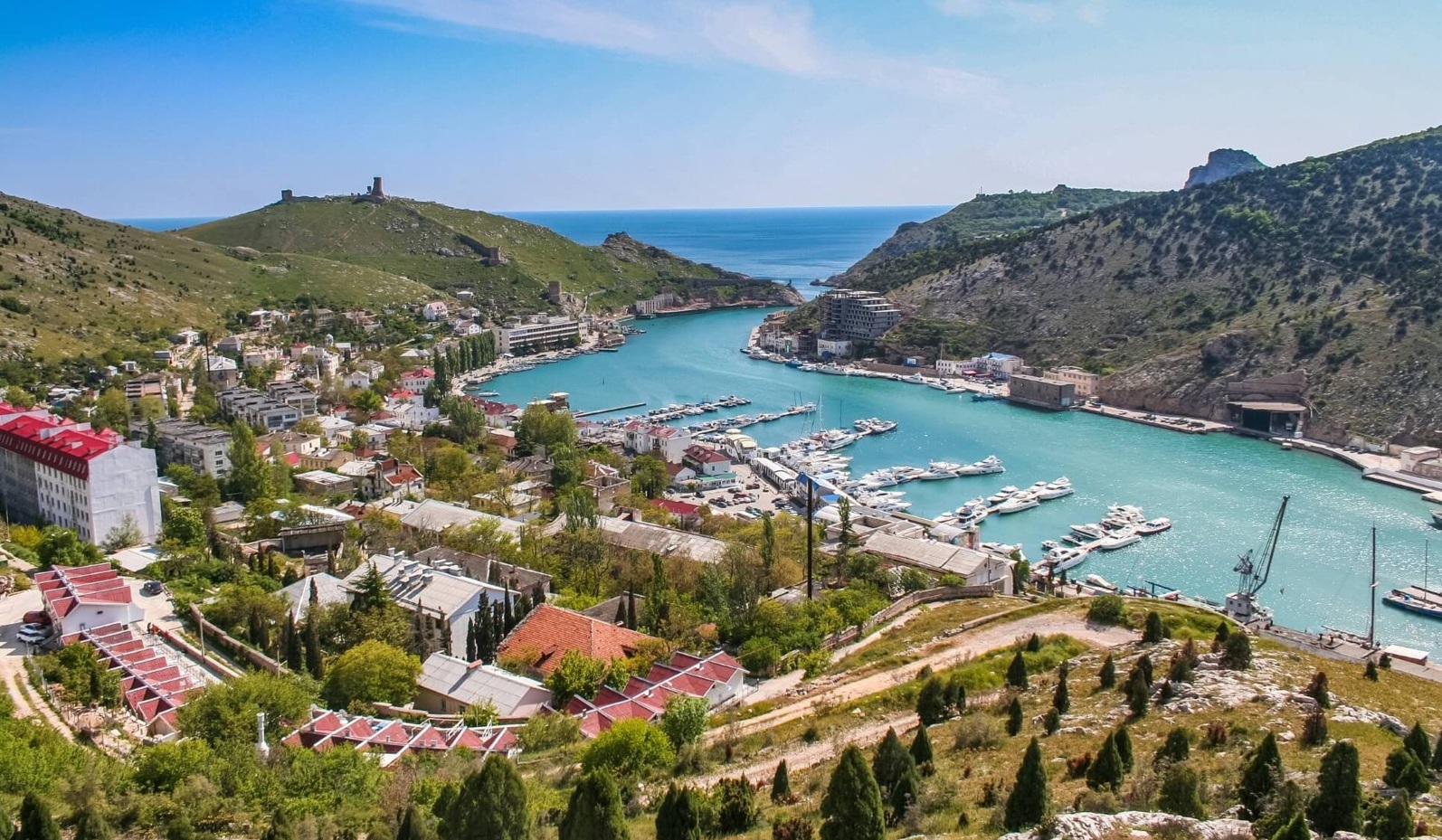
Balaklava Bay has turned into a massive construction site. Both waterfronts—Nazukin Embankment and Tavriya Embankment—are cluttered with heavy machinery and fences, behind which historic buildings are being demolished and piles are being driven into the ground for new piers. Companies linked to Arkady and Boris Rotenberg, friends of Vladimir Putin since the days of the so-called «Ozero» [Lake] cooperative, have appropriated the bay and its cultural heritage sites for a dubious project. Russian occupants are making hotels and apartments the dominant feature of the «new Balaklava,» leaving no room for history or the city’s residents. (Watch the video version of the investigation here).
To understand what the residents of Balaklava are losing and what they are getting in return, let us briefly trace the history of the bay over the past fifteen years. The idea of transforming Balaklava Bay into an attractive resort town with a yacht marina began to capture the imagination of local businesspeople and tour operators during the bay’s demilitarization. That is, after the collapse of the Soviet Union, the closure of the submarine repair and missile storage base, and the withdrawal of Black Sea Fleet units from the bay.
The site has a number of unique natural and historical features: wonderful sea bay, with an Ancient Greek myth of the Laestrygonians, a tribe of man-eating giants who attacked here the fleet of Homer’s Ulysses; the ruins of the Genoese fortress of Cembalo and the Ottoman fortress of Balaklava; the British garrison during the Crimean Campaign and Death Valley; Cold War artifacts at the museum of the underground submarine repair facility.
It would seem—what was needed to prevent this place from becoming a tourist paradise?! That’s right, corruption.
It was the explosive mix: the military—both retired and active-duty, Russian and Ukrainian—had their own interests at stake; businessmen, politicians, officials from both countries, and even President Yanukovych’s eldest son, Alexander (nickname – «Sasha the Dentist») who anchored in Balaklava back in 2006, when his father was Prime Minister of Ukraine.
Companies belonging to Alexander Yanukovych’s «MAKO» corporation took control of a particularly valuable section of Nazukin Embankment—right at the entrance to the bay and at the foot of Mount Castron, with the towers of the Cembalo Fortress. This area is home to cultural heritage sites—the house of Mayor Mikhaili and two estates belonging to actress Sokolova—a large wing and the main building.
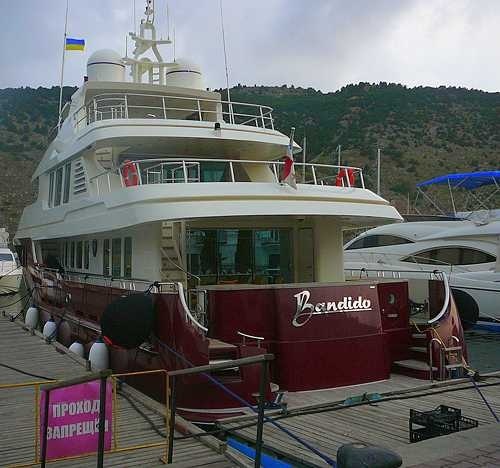
Super-yacht «BANDIDO» at yacht club of Yanukovych in Balaklava, 2010. Photo: lb.ua
Under the guise of restoration, they were dismantled piece by piece and reassembled, but their appearance still could not compare to that of the neglected monuments. The Yanukovych family’s private yacht club was also set up there, where journalists photographed their «BANDIDO» super-yacht and a couple of more modest vessels.
«Balaklava Green» of Novinsky
Balaklava, not as a small town on the outskirts of Sevastopol, but as a year-round resort of international standing. That was the vision behind the «Balaklava Green» project, which Vadym Novinsky’s «Smart Holding» team presented at an international forum in Cannes in 2011. As reported at the time, the project for the Balaklava resort and yacht marina was compared to Barcelona and the best resorts in Montenegro.
In addition to the marina itself, hotels of various categories, an equestrian club, a modern amphitheater, and an aquarium were planned for the sites of the former quarries operated by the Balaklava Ore Administration—Tavros, Gasforta, Psilerachi, and Kadikoy—where flux limestone was once mined.
The Ore Administration belonged to Russian citizen Vadim Novinsky. In 2012, he received a Ukrainian passport from President Yanukovych and a seat in the Ukrainian parliament from the Party of Regions. He became a partner of the most influential Ukrainian oligarch Rinat Akhmetov. Thus, the creation of a resort in the bay and on the site of the Ore Administration’s depleted quarries was intended to preserve 750 hectares of Balaklava land for the company «Smart Holding».
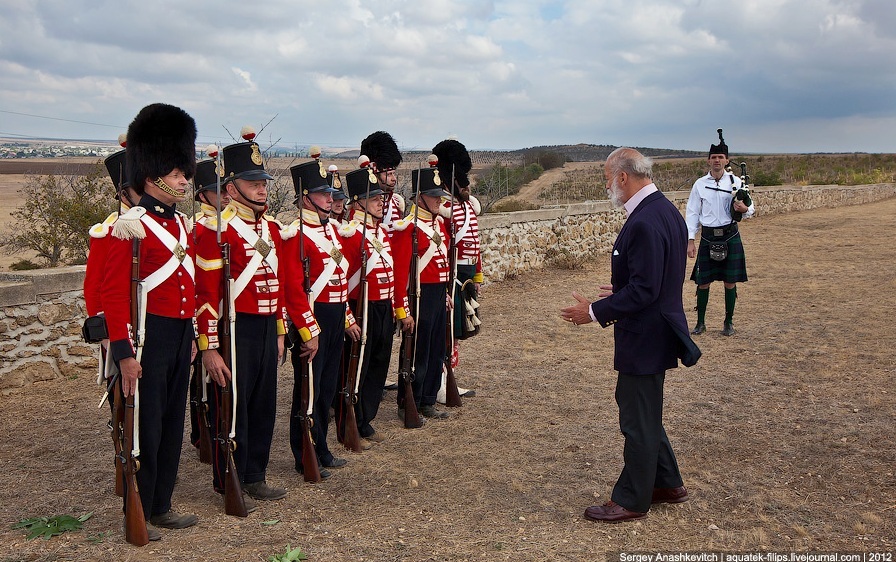
Prince Michael of Kent with British historical reconstructors on the field of the Battle of the Alma (Bakhchysarai raion, Autonomous Republic of Crimea), 2012. Photo: Sergey Anashkevitch
Prince Michael of Kent, a cousin of Queen Elizabeth II, agreed to serve as the project ambassador. Prior to the Russian occupation of Crimea, he used to visit Crimea to watch the annual reenactment of the Battle of Balaklava in the Valley of Death. It was reported that the project planned to attract investors from the Netherlands, Ireland, Italy, and Finland.
However, several factors hindered implementation of the project. As Oleksiy Korchmit, then Deputy Head of the Balaklava District State Administration, told CJI, these factors included: the presence of military units right in the center of the bay («Metalist» plant of the Ministry of Defence of Ukraine), the lack of wastewater treatment facilities (they still do not exist there) and the dependence of local budget on taxes from the Balaklava Ore Administration, which did not encourage the shutdown of its crushing plant within the city limits.
Everything changed in 2014 with Russian occupation of Crimea and Sevastopol. The cooperation with foreign investors, which had been built up over the years, came to an abrupt halt. Today, memories of the international project seem like an ironic anachronism—sanctions have turned Balaklava into an isolated zone. The priorities for the use of the bay have undergone a radical transformation. Instead of open competition for investment in the regional development, there are now direct directives from the Russian government favoring members of the «Ozero» [Lake] cooperative.
The initiative began with Vladimir Putin’s 2016 directive to establish a yacht tourism center in Balaklava as part of the federal target program for the development of the annexed Crimean peninsula.
«Development of Balaklava» from Rotenbergs
In 2017, the Russian «governor» of occupied Sevastopol presented Dmitry Medvedev with a model of the future marina at the economic forum in Sochi. It turned out to be… a stolen model of «Balaklava Green.» Project manager Sergei Ovchinnikov told CJI that the «government» of Sevastopol had approached him three or four times with an offer to consult on or even lead the «Balaklava Green» construction project: «But we do not work with the occupying authorities, so it was impossible to do so, even though the offers were becoming increasingly attractive from a commercial standpoint. Apparently, they never found anyone, so the project remained on paper».
At the same time, companies owned by Putin’s close friends – the Rotenberg brothers, who had secured multi-billion-dollar contracts to build the Kerch Bridge – began eagerly snapping up the finest properties in the resort complex of occupied Crimea.
In December 2017, the occupying government of Sevastopol, acting on the orders of Russian «governor» Dmitry Ovsyannikov, seized land plots and capital construction projects owned or leased by Ukrainian owners «for state needs» and for the construction of a yacht marina.
Next came the court cases aimed at «clearing» both embankments of the bay. Russian occupants shamelessly manipulated the decisions of Ukrainian courts. Thus, the Russian Ministry of Defense won a court case against LLC «Balaklavamegastroi» and appropriated pier # 248 on Tavriya Embankment which had been illegally seized from … the Ukrainian Ministry of Defense by the corrupt authorities of Sevastopol before Russian occupation. Now Russia has taken the pier and a section of the embankment into its «possession» based on a decision by the Sevastopol Economic Court from September 2009.
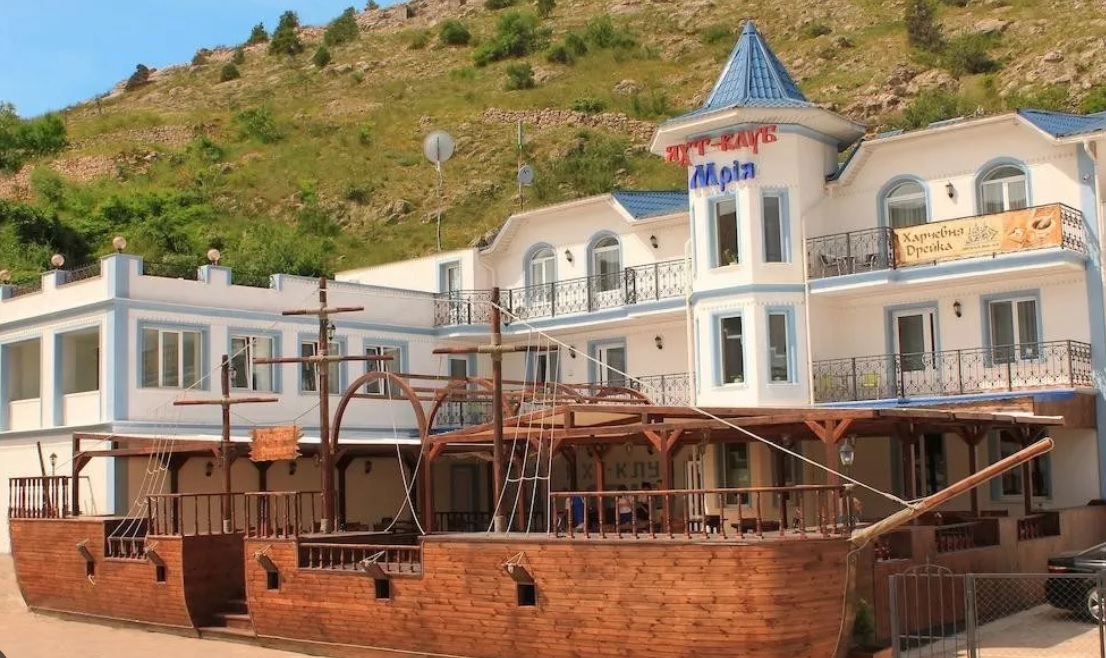
Yacht club in Balaklava, owned by the company of Dmitrii Sablin. Photo: 101hotels.com
The tragicomic thing about this story is that Dmitrii Sablin, a Member of Russian State Duma, one of the leaders of Putin’s political party «United Russia» and «the Fighting Brotherhood», has been the owner of «Balaklavamegastroi, which illegally appropriated two piers of the Ministry of Defense of Ukraine and the plot on which «Mriya» hotel and yacht club have been located (see CJI’s investigation about Sablin’s activities in Crimea for the benefit of Russia and himself).
At the beginning of the Russian full-scale invasion into Ukraine, Sablin created and led the volunteer military unit «GROM «Cascade», which grew into the first brigade of unmanned aviation in the Russian Aerospace Forces and became one of the most effective units of Russian occupants. However, these merits of Sablin to the Russian Fatherland are worthless if they stand in the way of the plans of Putin’s Laestrygonians. (read and watch CJI’s investigation of this brigade).
Two piers, part of the embankment, and all estates, previously owned by Yanukovych-junior, were seized.Yanukovych tried to save them and transferred to Russian citizen Elena Kazimirova but the trick did not work.
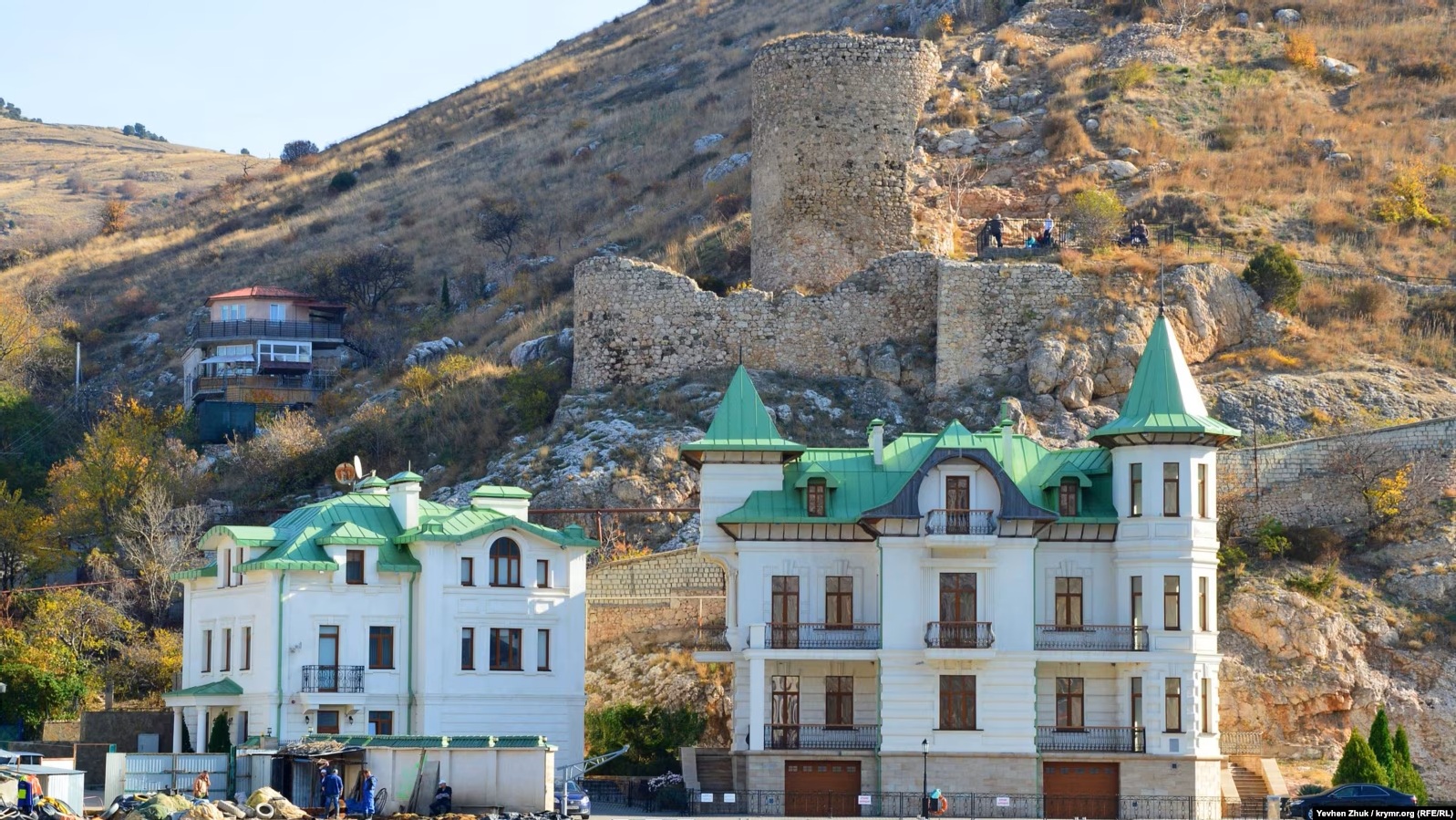
So-called «houses of Sasha Yanukovych» at Nazukin Embankment in Balaklava. Photo: Yevhen Zhuk / krymr.org (RFE/RL)
Before the Russian occupation of Crimea, the «Golden Symbol» Yacht Club, which owned and rented facilities on May 1st Square and Nazukin Embankment, belonged to Ukrainian citizen Andriy Senchenko and Serhiy Velizhansky, political and business partners. Through court decisons, Russian occupants took everything from «Golden Symbol»: the moorings, the territory, the hotel and house of Prince Yusupov. The company had to give up the 60-meter floating berth No. 261A as the repayment of the «debt» to the «Balaklava Development Project».
The crushing plant of Ukrainian oligarch Novinsky quickly moved from the bay to one of the quarries outside the city, but did not remain at a loss. On the contrary, it increased production: the Russian construction of the Kerch Bridge and «Tavrida» highway urgently needed crushed stone whereas Russian metallurgical industry, busy with defense orders, needed flux limestone.
In 2018, companies of Rotenbergs received the first permits for the development of Balaklava Bay. Their promises were tasty: a yacht marina for 600 vessels, a million tourists a year, restoration and preservation of all cultural heritage sites and a public space with a park – on the site of «Metallist» plant.
However, the sketch plan for the development of the central part of the bay was shown to the residents of Sevastopol only at the end of 2025, and sketches of hotels at the foot of the Chembalo Fortress were shown only in March of this year.
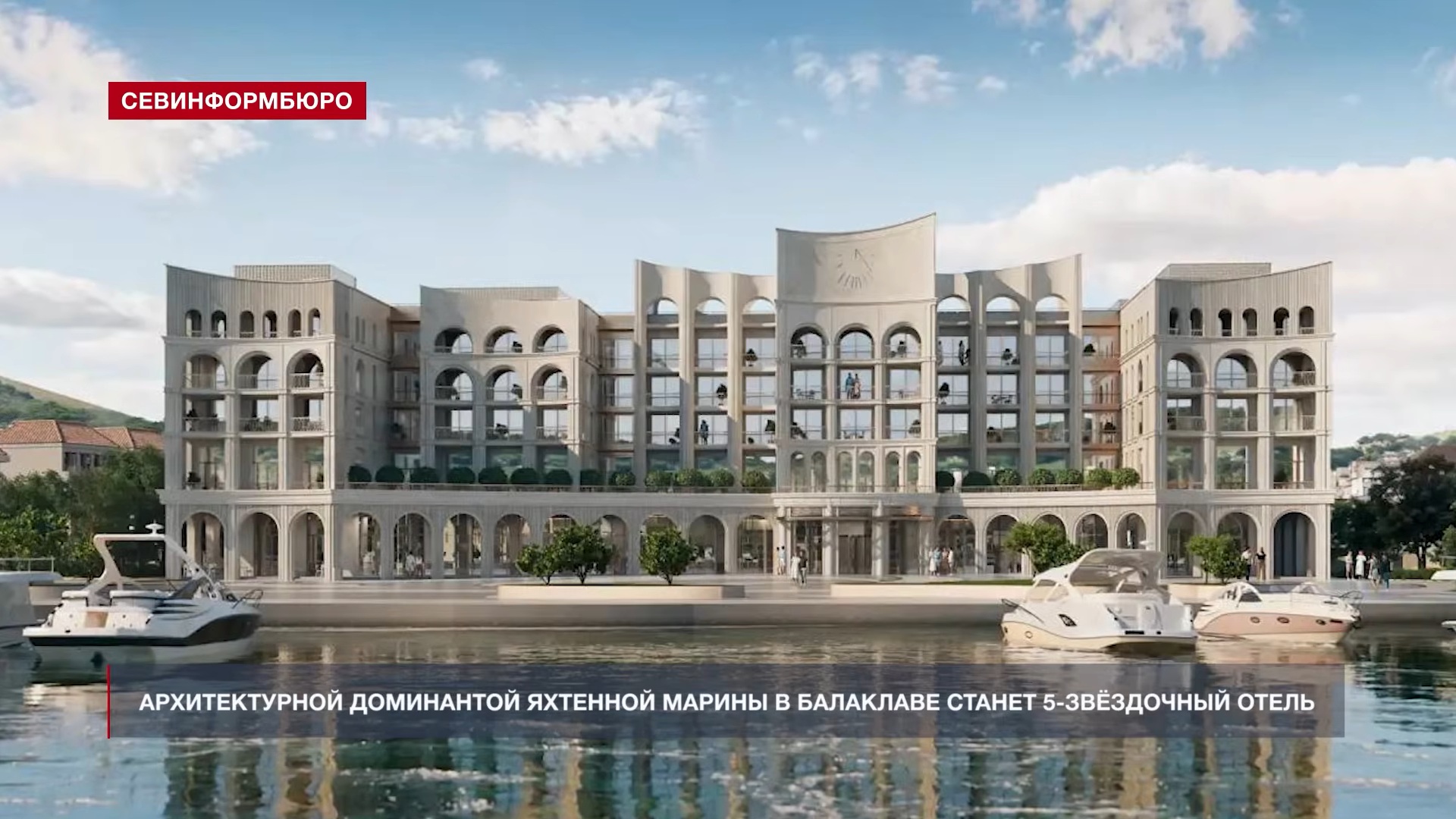
Sketch plan of 5 star hotel in the central part of Balaklava bay. Photo: screenshot of NTS video
Local Balaklava captains are surprised: the center of the bay will be dominated by two huge hotel complexes approaching the water line, and not promised public space with a park.
The people of Balaklava are lamenting that there will be no room for their ships, which they use to take tourists on boat trips, to beaches, and fishing trips, in the “new Balaklava.
«The picture will be cool, beautiful: there will be boats and everything will look great from the side. But there will be other owners [of the boats] – they will no longer be locals, because they will simply be «washed out», there will be no ordinary fishermen like us. This is basically everything that Balaklava started with, everything that always sounds like – these are the Laestrygonians, that is, fishermen», predicts local yacht captain Malko.
The traitor Tetyana Lobach, who was promoted by Russian occupants to Russian State Duma, tried to calm the captains. For this reason, it is likely that her restaurant «Tatyana’s Cape» on Nazukin Embankment, continues to operate, although it was included in the list of objects for demolition.
«When reconstructing Balaklava Bay, fishermen must remain. They need to a place to park. This is Balaklava, this is fishing, this is our highlight, these are the descendants of the Laestrygonians», promised Lobach.
It is high time to stop recalling Laestrigonians, as writer Aleksandr Kuprin called local Greek fishermen. There are no descendants of Vanya Andrutsaki, Kolya Kostandi and Yura Paratino (figures of Kuprin’s novel) anymore in Balaklava. In 1944, they were deported by Stalin regime from Crimea, together with Crimean Tatars.
Now genuine man-eating Laestrygonians entered Balaklava bay – business founders of Putin’s regime. They swallowed Balaklava as mythical giants swallowed the ship of Ulysses. Russian oligarchs are not able to transfer their money abroad anymore. They will invest them into occupied Crimea and use Russian budgetary resources at the same time. Today the Russian budget finances dredging works in the bay and reconstruction of embankments. But the fruits will be reaped by Rotenberg brothers.
Monopoly acquisition of the bay
The general contractor for the construction of the yacht marina and everything around it is Russian JSC «Mostotrest». Its beneficial owner, through LLC «Stroyproektholding», is billionaire and Putin’s friend Arkady Rotenberg. The company that built the Kerch Bridge is now dismantling the history of Balaklava.
Some renowned objects like cinema theatre «Rodina» [Motherland] and hunting house of Prince Yusupov were sold at open auctions.
However, the majority of deals were hidden. Civic activists found information about them thanks to leakage of permits. Local journalists asked Russian LLC «Port-Lamos» about number and list of objects this company acquired in Balaklava. Its press service answered that «houses under reconstruction on embankments of Balaklava bay will be adjusted for modern use and become new publicly accessible tourist objects».
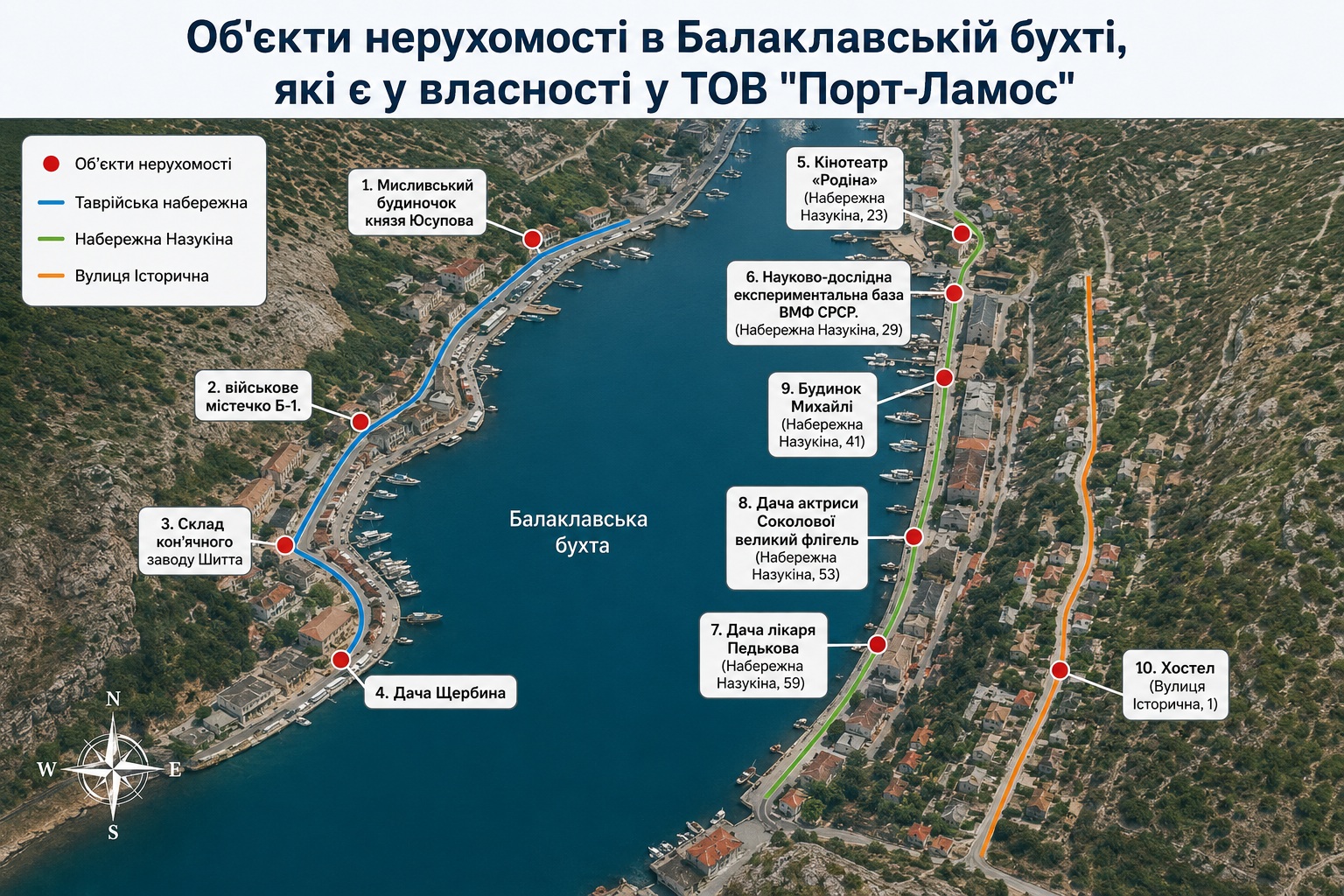
Property objects acquired by LLC «Port-Lamos» in Balaklava. Infographics created with an assistance of Chat GPT
Thus, key assets in Balaklava bay (land plots, embankmentplots, property objects, including ojects of cultural heritage, piers etc.) are now controlled by companies «Port Lamos» and «Deli-Christo». Besides that, a number of other interconnected legal entities have been involved into acquisition and construction in the bay.
Earlier Rotenberg brothers used the scheme of closed mutual investment funds and related management companies «to acquire» the pearls of Crimean resort assets, Yalta sea port and Crimean chemical plants of Ukrainian oligarch Firtash. These funds are not registered as ordinary legal entities whereas their participants are not disclosed.
For their «project of Balaklava development», Rotenbergs used already known mutual investments funds «Angazhe» and «Financial partner».
To grasp the scale of Rotenbergs’ scheme, it should be noted that «Financial partner» has 34 «daughter» companies and it is the management company of 44 mutual investment funds! All of them are included into the register of Russian bank «Rossia», owned by other Putin’s friends – Kovalchuks brothers. Another interconnected management company «Fin-partner» controls six mutual investment funds. Aleksey Sorokin is the fake founder of «Financial partner» and «Fin-partner».
The chronology of the emergence of Rotenbergs’ legal entities around Balaklava looks as follows. In 2021, closed mutual investment fund «Angazhe», managed by «Financial partner», founded in Moscow LLC «Yug holding». Next year this «Yug holding» founded company «Ritoris» and later renamed it into JSC «Yuginvestproekt». All these companies then founded or acquired a number of companies, specialized developers, which entered construction markets of Sevastopol and Balaklava. These developers include LLC «Port Lamos» and «Deli-Christo», «Bely gorod» [White city] and «Tavros» (founder of LLC «Grand Balaklava» and «Zavod Shitta»). «Yuginvestproekt» is the management core of these companies.
Up to liberation of Crimea and Sevastopol from Russian occupants, these companies will shape the destiny of Balaklava and its residents. For example, their plans include the construction of hostel on Historical street near Nazukin Embankment. Residents of this street told that representatives of «Port Lamos» proposed them to sell their houses. As businessmen explained to residents, old houses will be bad for the view of beautiful yacht marina…
In 2022, the construction of yacht marina was launched on Tavriya Embankment. It has been blocked. For two years, Balaklava residents has lost access to local beaches «Vasyli» and «Marmurovy» whereas tourists could not access the museum of Soviet submarines created by Ukrainian historians.
At the beginning of June this year, Russian occupation administration of Balaklava and «Mostotrest» closed free access to Nazukin Embankment and neighboring streets for the whole resort season.
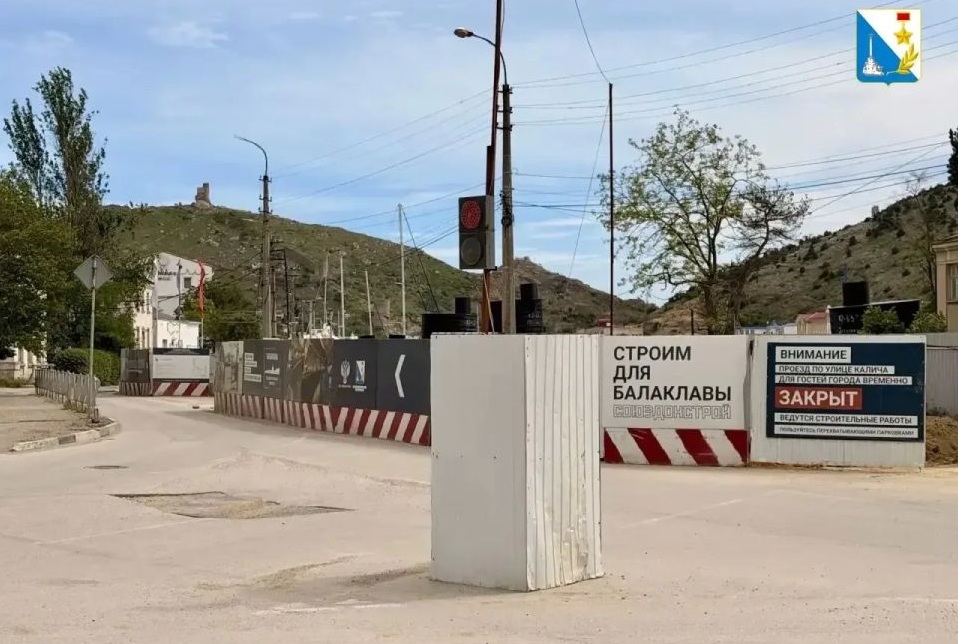
Developer of Balaklava bay JSC «Mostotrest» of Rosenberg brothers closed access to Nazukin Embankment for the whole summer. Only local residents, public officials and ship owners will be let in. Photo: social media of Russian occupation government of Sevastopol
Russian state unitary enterprise «Project of development of Balaklava» administers the acquisition of objects and land plots in the bay. This enterprise terminates leasing agreements or «nationalizes» property objects and land plots into the city ownership by court decisions. Since last year, the enterprise has been managed by Russian citizen Yuri Alekseevich Baranov. Earlier he has managed Sevastopol Sea Port for five years. As Russian opposition newspaper «Novaya Gazeta» reported, Baranov had dubious business past. He managed or owned dozens of companies – from repair shop and wholesale trade to advertisement agencies. All of them were liquidated. That is to say, he served as fake owner or manager for influential people behind him.
It is remarkable that since 2024 enterprise «Project of development of Balaklava» has been given status «in the process of reorganization». Russian occupation authorities plan to privatize it and turn into the joint stock company. Who will be the main beneficiary? The answer is obvious – Rotenberg brothers. But for the time being, this state enterprise transfers valuable assets from the city and its residents to companies connected with Rotenbergs.
Bulldozer archeology
According to the Russian Act of state historical and cultural expertise, both sides of Balaklava bay have 44 objects of cultural heritage. Plans of future development of Balaklava bay promise to preserve them and build a number of lucrative hotels, yacht marina etc. But it is obvious that small bay cannot include them all. Russian occupation authorities and people of Rotenbergs found simple solution – we will demolish everything impeding our plans!
The order of Sevastopol occupation authorities from April 14, 2022 described 30 commercial estates and objects of cultural heritage to be demolished. At the end of 2022, the dismantling of «Metallist» of the Ministry of Defense of Ukraine was launched. As CJI reported, in 2024, military units of Border Service of Russian Federal Security Service and Federal Guard Service were removed from the bay. As an outcome, the central part of the bay was cleared for the construction of hotel complexes.
Tavriya Embankment includes a number of dacha houses of the beginning of XX century: houses of engineer Zavadsky «Fata Morgana», doctor Pedkov and Scherbyna. Here are also warehouse of cognac factory of Shitt, hunting house of Prince Yusupov. These houses are objects of cultural heritage.
All of them will be turned into hotels and restaurants, as was disclosed at the session of city architectural council about reconstruction plans of Balaklava bay.
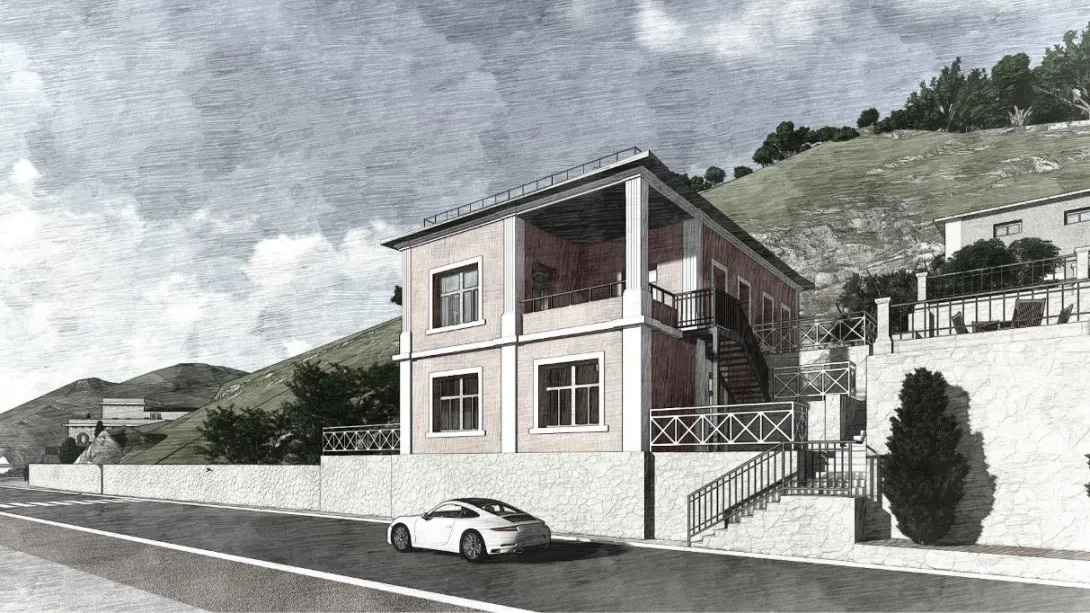
Sketch of hotel on the site of house of Scherbyna. Photo: sevastopol.su
As Evelina Kravchenko, a senior researcher at the Institute of Archaeology of the National Academy of Sciences of Ukraine, says, the main emphasis of Balaklava will be the parking of yachts and the construction of hotels in all permissible and unacceptable places for this:
«The fortress of Chembalo, the dominant feature of architectural and cultural heritage in Balaklava, fades into the background. The same will happen with the Old Roman camp in Kadikoy. Thought it is not very attractive, it is the most important of all objects of cultural heritage in Balaklava because it is one of a few objects of such a type on the Black Sea. The temple of Jupiter Dolichen will also fade into the background (it was excavated and could be exhibited). Even the historical heritage of the times of the Russian Empire fades into the background: the dachas of the Russian aristocracy, the intelligentsia, related to names of Lesya Ukrainka, Paustovsky, Kuprin»
Active works are conducted on the opposite side of the bay – on Nazukin Embankment. Cinema theatre «Rodina», built at the beginning of the XXth century, was closed in the middle of 1990s. In 2024, it was sold to LLC «Port Lamos». The company promised to repair it.
In January 2025, Ivan Bukalov, the manager of repairing works, told local TV that restoration of the theatre progressed well but one wall of the theatre fell apart in several months. The deadline for the completion of work was prolonged until 2028.
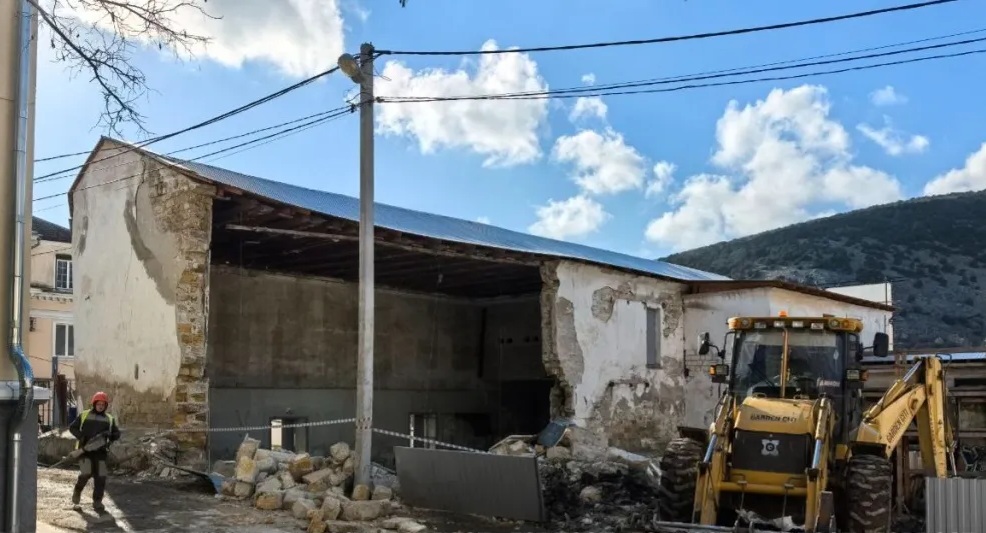
The wall of cinema theatre «Rodina» / «Mon Repos» fell apart during construction works on February 19, 2026. Photo: ForPost
February 2026 was marked by full scale demolition on Nazukin Embankment, 29. Entertainment center «Academy of spying» has been located there. It worked on the ground of the former 184th research experimental base of Soviet Navy, known for its training of dolphins. The building was acquired by LLC «Port Lamos». It plans to build large hotel complex there.
In order to build large hotel complex (9 thousand square meters) at the foot of Kastron Mountain, significant part of the object of cultural heritage «Northern Suburbs of Cembalo Fortress» had to be cut. Sevastopol company «Archeological and interdisciplinary studies» has conducted archeological «excavation» there during only two months, in March-April 2026. Russian citizen from Lipetsk Smolyaninov Roman Viktorovich signed the Act of state historical and cultural expertise and confirmed that the land plot has been fully researched by archeologists and «could be transferred into commercial use».
It turned out that Smolyaninov has been countryman of Aleksandr Bachurin, co-founder and director of Sevastopol company which conducted turbo-excavation. LLC and NGO of Smolyaninov had similar name – «Archeological studies».
Another expertise was conducted by Yuri Zaitsev, director of historical reserve «Neapol Scythian». It has been about project of sewage collector near medieval fortresses Cembalo and Kalamita (they are part of reserve «Khersones Taurian»). Zaitsev stated in his conclusion that preservation of above mentioned objects of cultural heritage was «possible» when yacht marina would be built.

Evelina Kravchenko, PhD in History, senior researcher of early Iron Age archeology department of the Institute of Archeology of the National Academy of Sciences of Ukraine. Photo: Facebook Evelina Kravchenko
As Evelina Kravchenko notes, such loyal expert opinions are commonplace in Russia. It is enough to point out that any construction that falls on an archaeological site will be carried out under the supervision of archaeologists. And we saw this during the construction of the Tavrida highway, when archaeologists were allowed to quickly dig after bulldozers had passed there. The same picture is in the case of the archaeological sites of Balaklava.
«Archaeological research begins after construction equipment, bulldozers, and excavators have traveled to the archaeological site. Visually, it is clearly visible that the soil has actually been removed. I know very well the accumulation and quality of soils in Crimea and Sevastopol, because I have excavated these soils with my own hands», says Evelina Kravchenko. «And to write that engineering communications will be laid here and there and it will not affect [archaeological sites], as it is written in the expert report, is a crime. Communications will take place along archeological sites».
According to Evelina Kravchenko, this Balaklava development project is the formation of a completely new direction in the development of the history of urbanism, «which can actually be called urban fascism, when all previous urban periods of history and approaches are completely leveled and a completely new, alien and hostile to previous urban style is created».
The dirty and smelly secret of yachting luxury
And finally, the most acute problem of Balaklava is ecology. The city does not have a full-fledged sewage treatment plant and sewage still flows into the sea. At the exit from Balaklava Bay, the place of sewage discharge is visible to the naked eye, because here the sea blue is crossed by a brown river of sewage.
In 2021, the Russian occupation government of Sevastopol refused to build modern local wastewater treatment plants directly in Balaklava. Instead, they are building a «giant pipe» (collector), which will be stretched to the «Pivdenny» wastewater treatment plants. This is approximately 12-15 kilometers of pipes along the coast from Balaklava to Kamyshova Bay, where the «Pivdenny» wastewater treatment plant is located.
But here is the trouble: these treatment facilities, which the Russian occupants have been modernizing for ten years, have still not been put into operation. During this time, their cost has increased from 8.1 billion rubles to over 20 billion. It is important to understand that this amount does not include the cost of the Balaklava collector and makes the real price of cleaning the bay even higher. The only thing the Russians can boast about is that sewage flows into the sea through a pipe ten meters from the shore.
In addition, «Pivdenny» is technically unable to cope even with the current load. Because the Russians implement a project proposed to Sevastopol back in the late 80s of the last century. Sevastopol ecologist Margarita Litvinenko calls this a rejection of modern technologies in favor of primitive dumping of sewage into the sea. This is not development – this is ecological murder of the bay for the sake of saving the investor’s money
The story of the «development of Balaklava» is far from over. However, legal entities and individuals who are the organizers and executors of the criminal development of Balaklava Bay and numerous cases of the same criminal appropriation of Ukrainian state and private property, in particular and especially cultural heritage sites, must be sanctioned and brought to justice now.